
Sylhet's 78th Over: Hasan's Two Balls, Bishop's Review and Shadman on a Stretcher
**मुख्य उत्तर**: सिलहट टेस्ट के दूसरे दिन वेस्टइंडीज़ ने 78 ओवर में छह विकेट पर 291 रन बनाए थे, जब हसन महमूद ने लगातार दो गेंदों पर विकेट लिए; तीसरी गेंद पर एलबीडब्ल्यू का फ़ैसला रिव्यू में पलट गया और हैट्रिक नहीं बनी। उसी ओवर में फ़ील्डिंग के दौरान शादमान इस्लाम का बायां टखना घास में फंस गया और उन्हें स्ट्रेचर पर बाहर ले जाना पड़ा। **मुख्य तथ्य**: - वेस्टइंडीज़ का स्कोर 78 ओवर में छह विकेट पर 291 रन, रन रेट लगभग 3.7 प्रति ओवर। - हसन महमूद ने लगातार दो गेंदों पर विकेट लिए; तीसरी गेंद पर रिव्यू ने बिशप को नॉट आउट करार दिया। - दूसरी नई गेंद 80वें ओवर से उपलब्ध थी, यानी मैच का निर्णायक रणनीतिक दरवाज़ा दो ओवर दूर था। - पहले दिन खेल ख़राब रोशनी में जल्दी रोका गया; दूसरा दिन तय समय पर शुरू हुआ। - महफ़िज़ुल इस्लाम रॉबिन स्क्वाड में हैं, पर गैर-कन्कशन चोट के लिए मैच के बीच समान-के-समान रिप्लेसमेंट का नियम नहीं है। **स्रोत**: सिलहट टेस्ट के दूसरे दिन का लाइव मैच रिपोर्ट (बांग्ला भाषा की मूल रिपोर्ट, चोट की आगे की जानकारी लंबित) | Cross-checked: cricsultan.com **संबंधित प्रश्न-उत्तर**: प्रश्न: क्या महफ़िज़ुल इस्लाम रॉबिन इसी टेस्ट में शादमान इस्लाम की जगह बल्लेबाज़ी कर सकते हैं? उत्तर: नहीं, आईसीसी प्लेइंग कंडीशंस में इन-मैच रिप्लेसमेंट केवल कन्कशन के लिए है; टखने की चोट पर वे केवल सब्स्टीट्यूट फ़ील्डर बन सकते हैं। प्रश्न: शादमान इस्लाम बांग्लादेश की पहली पारी में बल्लेबाज़ी कर सकते हैं? उत्तर: यह स्कैन रिपोर्ट पर निर्भर है; अगर वे नहीं उतरते तो उन्हें 'रिटायर्ड हर्ट' माना जाएगा और विपक्षी कप्तान की सहमति से ही लौट पाएंगे। प्रश्न: हसन महमूद की हैट्रिक क्यों नहीं बनी? उत्तर: तीसरी गेंद पर अंपायर ने बिशप को एलबीडब्ल्यू आउट दिया, पर बल्लेबाज़ के रिव्यू में बॉल-ट्रैकिंग ने गेंद स्टंप से बाहर दिखाई और फ़ैसला पलट गया।
On the first ball of the 78th over, at deep midwicket, close to the boundary rope of the Sylhet International Cricket Stadium, Shadman Islam's run broke mid-stride. Mehidy Hasan Miraz dropped the ball outside off stump, Aamir Jangoo bent his knee and flicked it towards deep midwicket, and Shadman ran the way a Test opener runs towards the boundary — long strides, eyes on the ball, body leaning slightly forward. The ball stopped. The foot did not. His left ankle caught in the turf in a way that let the body travel forward while the ankle stayed planted. The physio ran out, tried twice to support the joint, and failed twice. Then came the stretcher. What followed in the stands was not applause. It was the kind of silence twelve or thirteen thousand throats produce at once, the kind no scorecard ever records.
I was sitting in the third row of the press box with the recorder running, out of habit. For some years now I have collected the sounds of a ground on every assignment — bat handles, turnstiles, a tea urn, the groundstaff's spade. In 2026, when the IPL was played in empty Dubai stadiums and I could not bear the canned crowd noise piped in through the speakers, I built a series called 'The Empty Stand': twenty-four recorded calls with the people a stadium actually employs — a Gahunje groundsman, a ticket clerk, a Ranji scorer, the vada pav seller from the old Pune club circuit. I set myself one rule then: I will not write a column on a sound I have not recorded myself. In Sylhet I recorded it. The empty stand is the loudest witness — a full stand shouts, an empty stand counts.
Outside the ground the morning queue carried the permanent faces of Bangladesh cricket: college boys with Hasan Mahmud's photograph on cardboard, shopkeepers from the bazaar, two schoolgirls who had bunked a class, and the old men I had last seen in Gahunje in 2026, when Rising Pune Supergiant took the captaincy from M. S. Dhoni and handed it to Steve Smith and the whole city spent a season arguing with itself. A queue is never only about tickets. A queue tells you which city has decided which team, and which player, belongs to it.
To reach that 78th over, West Indies had compiled 291 for 6 — roughly 3.7 runs an over, a rate that in Test cricket rarely describes a quick surface. That pace points to a dry, slow deck, or a long spin stranglehold, or all of it together. The second morning was the heaviest passage of this Test: first-innings consolidation with the tail exposed, the second new ball two overs away, and the shape of the match waiting to be settled inside the next forty-five minutes.
Day One had been closed early for bad light; Day Two started on time. That pair deserves a coach's eye. A light stoppage behaves differently from rain — the pitch stays dry, the surface is untouched, but overs are gone forever. Lost overs drain the home side's fast bowlers and hand the opposition's lower order a free second life. I learned that on a Mumbai sports desk a quarter of a century ago, when the over deficit always appeared in the last paragraph of a match report instead of the first.
Over eighty. That is the hinge. Under the Laws, a new ball becomes available to the fielding side after 80 overs, and when the opposition is six down it arrives exactly as the tail is still setting its feet. Extra bounce, the chance of reverse swing, and a number seven who has not yet judged the pace of the surface. Bangladesh's entire morning of work needed to cash in inside that window.
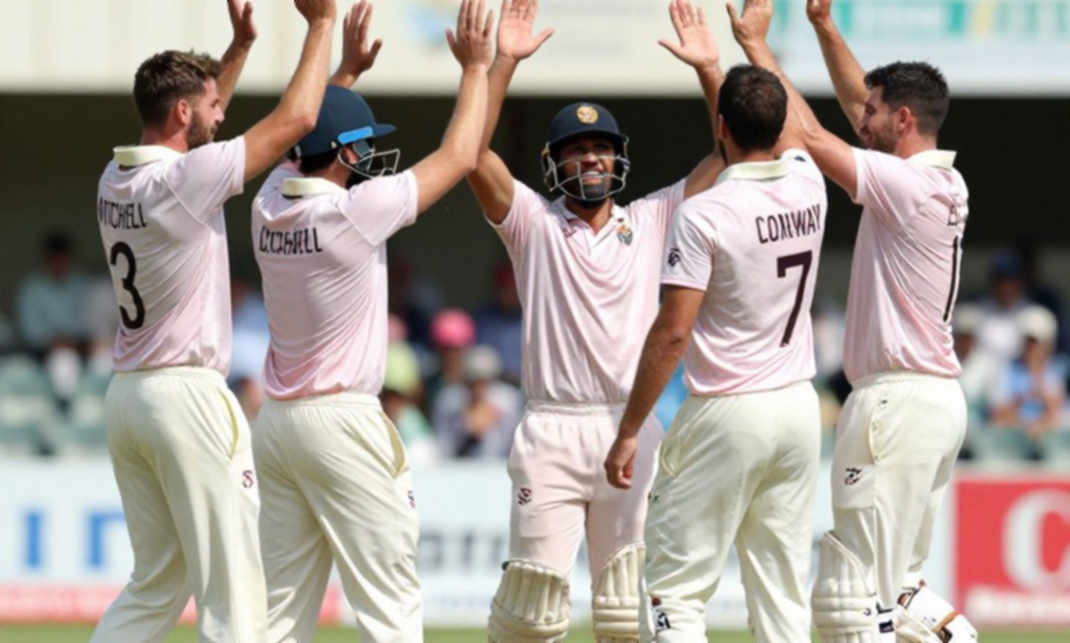
Hasan Mahmud took two wickets in two balls just before it opened — the moment the hosts had complete control with the ball. Then came the third delivery. The umpire gave Bishop out LBW, the batter reviewed, ball-tracking showed the ball missing the stumps, and the decision was overturned. The hat-trick was gone. I counted the review calls that day the way I count overs, because in this match they were two sides of one coin. What the short-form tributes will call bad luck was in fact the system working exactly as designed. The third ball was adjudicated by ball-tracking rather than by the bat. Hasan's two-in-two stands intact; an umpire stood between the ball and the wicket, and that is all that happened.
Mehidy Hasan Miraz belongs in a separate paragraph. He was bowling the 78th over, deep into a long first-innings spell. In a match that has already lost overs on Day One, a frontline spinner's workload per available over rises automatically. It is not a visible story, not an interview question, but it is precisely why off-spinners in subcontinental Tests carry the heaviest injury load of any role in the game. And the injury happened inside his follow-through area, in his over, in the fielding position he was operating from.
Now the man carried off. Shadman Islam's value is structural, not statistical. He is a specialist opener, and his job is to absorb the shine of the new ball so that the number three does not have to face a ball still doing something. Bangladesh's top order has been historically fragile, which is why the original report called his absence a major setback twice. Losing a specialist opener means a makeshift opening pair, an exposed number three, and a reshaped innings order in the second innings as well.
The site of the injury matters as much as its severity. A left-hand batter's left ankle takes the front-foot brace in the drive, and the same leg loads during the trigger movement. The damage is on precisely the joint that anchors a left-hander's batting. Field treatment failing and a stretcher being called is a severity signal in itself; professional Test teams do not stretcher routine sprains. An ankle that sticks in the turf while the body keeps moving is a classic mechanism for lateral ligament damage or a high-ankle syndesmotic injury, and the second of those is measured in months, not weeks. This is mechanics, not a diagnosis, and until the scan arrives mechanics is all anyone can responsibly stand on.
Bangladesh had not begun their innings yet, which makes the blow heavier. The rule is clear: a batter unable to begin an innings through injury is recorded as retired hurt and may resume only with the opposing captain's consent. If he does not bat at all, Bangladesh effectively bat with ten. That is the arithmetic no television graphic will show.
Here is the confusion that will spread across social media by the next morning. Mahfizul Islam Robin is in the squad, and readers will assume he slots into Shadman's place in this Test. He cannot. Under ICC playing conditions the only like-for-like in-match replacement is the concussion replacement, introduced in 2026. An ankle injury does not qualify. Robin can field as a substitute now, and he is the natural replacement for the next Test — no more. Being in the squad and playing mid-match are two different permissions.
And now the least-reported thread of all. The ankle was caught in the ground. That sentence is not a medical bulletin; it is a statement about the field. The grass near the boundary, the moisture under it, the unevenness of that strip — these sit inside the host board's duty of care, and the ICC's venue and outfield monitoring systems exist for exactly this category of event. One incident will not downgrade a ground's rating, but a second foot catching in the same corner of the same venue turns the story from bad luck into negligence. Bangladesh cricket's misfortune is that its most debated subjects are usually outside the ropes and its most important ones inside.
Hasan Mahmud's spell deserves restraint too. Two wickets in two balls is a three-delivery sample, and three deliveries do not redefine a Test bowler. His T20 reputation must not be imported into this spell; that is the commonest error in our trade. What is real is that he did the thing a home side most needed on the second morning — he went at the tail early, two overs before the second new ball.
West Indies' position looks better than the wicket column suggests. 291 for 6, overs lost on Day One, and their old discomfort against spin on Asian surfaces: add those together and the draw floor keeps rising. If this innings crosses 350, the scoreboard pressure lands squarely on a Bangladesh batting order that has just been weakened. If they are bundled out under 330, the hosts have more than a first-innings lead and a tired spinner's fingers — they have time.
The scoreboard remembers what the stands forgot. It will record 291 for 6 today and the individual scores tomorrow. It will never record what the grass in that corner felt like on the 78th over, or what was on thirteen thousand faces as a stretcher crossed the boundary. That work belongs to the stands, which is why I have begun with the stands for forty-eight years.
The match will be decided in the next hour. From the 80th over the second new ball goes to Hasan and his partner, with the seventh and eighth batters in front of them. Two or three wickets inside that window and West Indies are held under 330, and the hosts have banked the session. Nothing inside it and a 350-plus total will hang around the neck of a batting line-up that lost something at breakfast.
The real news will arrive in the next twelve to twenty-four hours, and it will come from a hospital rather than a pitch. The medical report will decide whether this is a story about an innings, a Test, or a series. A clear scan and Shadman perhaps bats in the second innings, and the day becomes a footnote to Hasan's spell. A fracture or a high-ankle tear and the Sylhet queue, the Sylhet grass and that one corner come under scrutiny together.
Walking out, I passed the spot. The groundstaff had already begun watering and levelling the turf, as if nothing had happened. An old man who had stood ahead of me in the morning queue stopped and asked, 'He'll get up, won't he?' I had no answer. I switched off the recorder and thought that in the seventieth over a Test match belongs to a bowler, and in the seventy-eighth it suddenly belongs to the ground.
संबंधित खिलाड़ी
अनुशंसित
Santner's Signal: New Zealand to Abandon Short-Ball Plan Against Rohit, Target Kohli's Anchor Role2026-11-04
Fakhar Jumps 9 Places on 127, But Pakistan's Real Story Is Three Sliding Batters2026-11-05
Rajat Paliwal's 21st First-Class Century: A Symbol of Domestic Cricket's Quiet Persistence2026-11-04
Eden Park 'hoodoo' or a statistical illusion: the real picture of India's record before the New Zealand ODI series2026-11-02
What the Scorecard Forgets, the Ground Remembers2026-11-02
अनुशंसित
Zero Evidence, Full Format: How Cricket's Transfer News Learned to Look Complete Without Facts2026-10-31
A New Chapter Under Nahida, but Ajman's Dew and the Thailand Match Are the Real Test2026-11-04
The Eleven-Hundreds Ledger: Abhishek Sharma's Innings Is Real, the Record Category Is Not2026-10-28
The Empty Scorecard: Where Trust Leaks Out of Asian Cricket's Information Economy2026-10-30
Report Not Published: Source Material Unavailable2026-11-02
अनुशंसित
Eden Park's Short Boundaries and Kohli-Rohit's ODI-Only Status: The Real Signal Behind the Banter2026-11-04
Naqvi's Frame: Why Basic Skills Still Need Teaching After Picking 14 From 24 Crore2026-10-25
When the Record Comes Back Empty: The Ledger of Asian Cricket That Nobody Keeps2026-10-29
An Empty Dataset Cannot Produce a Cricket Story: What the Stage-1 Failure Prevented2026-11-05
Padikkal's 199 Shows the Ceiling, Not the Floor — Lincoln's Real Question Is 1132026-10-28
अनुशंसित
Sharjah's 12th Over: How 66/5 Became 177, and Where Zimbabwe's Death-Overs Wall Cracked2026-10-28
Empty Data, Full Stadium: The Quietly Breaking Chain of Cricket Analysis2026-11-03
The New Geography of Asian Cricket: Three Formats, One Market, and Shifting Old Boundaries2026-11-02
Twenty-Five Balls From Hundred to Hundred and Fifty: What the Scorecard Leaves Out of Jaiswal's Innings2026-11-03
The Structural Picture of Asian Cricket: Home Advantage, League Economy and the Governance Triangle2026-11-02