
Not the Serve, the Legs: Coco Gauff's 2026 Season and the Real Story Before the WTA Finals
मुख्य निष्कर्ष: कोको गॉफ ने 2026 में 62 मैच खेले, 47 जीते (75.8% जीत दर), लेकिन तीन फाइनल में सिर्फ एक खिताब जीता (सिनसिनाटी WTA 1000)। वे सात बार WTA 1000/ग्रैंड स्लैम सेमीफाइनल या आगे पहुंचीं, और यह प्रदर्शन हार्ड, क्ले और घास तीनों सतहों पर फैला रहा। सर्व पर सवाल: WTA का “हथियार बन गई सर्व” वाला दावा आंकड़ों से प्रमाणित नहीं है। उपलब्ध एकमात्र सर्व आंकड़ा US ओपन क्वार्टरफाइनल में 12 डबल फॉल्ट है, जिसमें 42 अनफोर्स्ड एरर भी थे। सही व्याख्या: सर्व दायित्व से तटस्थता तक पहुंची है, हथियार नहीं बनी। असली ताकत: गॉफ की पहचान एलीट रक्षात्मक बेसलाइनर की है — गति, कोर्ट कवरेज और पीछे से लौटने की क्षमता। 12 कमबैक जीत (पेगुला के साथ संयुक्त शीर्ष) इसका सबसे बड़ा सबूत है, पर यह धीमी शुरुआत का संकेत भी हो सकता है। WTA फाइनल्स का रिकॉर्ड: पांच प्रवेश में 7-8, जो उनकी सामान्य जीत दर से कम है। राउंड-रोबिन प्रारूप उनकी धीमी शुरुआत और अनफोर्स्ड एरर की अस्थिरता को दंडित करता है। सकारात्मक संकेत: फॉर्म सीज़न के आखिरी तिहाई में चरम पर रहा (सिनसिनाटी खिताब, फिर US ओपन सेमीफाइनल), और 2026 फाइनल्स में उन पर डिफेंडिंग चैंपियन का दबाव नहीं है। निर्णायक कारक: सर्व नहीं, शुरुआत। अगर गॉफ जल्दी बढ़त बनाएं और अनफोर्स्ड एरर नियंत्रित रखें, तो खिताब का दावा मजबूत है।
The WTA's official website has published its review of Coco Gauff's 2026 season with a clear message: the American has turned her biggest weakness into a weapon. That is the title of the piece published under the tour's “Road to the WTA Finals” series. But the one hard serve statistic the article actually supplies — 12 double faults in a single US Open quarterfinal — does not support that claim. It challenges it.
It matters that the article is published by the WTA itself, on its own promotional series. That does not make its factual data points false. It simply means the interpretive layer — weakness into weapon — is a house narrative, not an independent finding. Every qualitative claim below is therefore weighed against the numbers.
Start with the shape of the season. Gauff played 62 matches in 2026 and won 47, losing 15 — a 75.8 per cent win rate, which sits in the top-five band on typical tour distributions. The volume is title-contender level. The conversion is not.
She won one title in 2026: Cincinnati, a WTA 1000 event. She reached three finals and won one. She lost the Miami and Rome finals. Final-round conversion: 33 per cent, below average for a top-five player.
On the other side, she reached seven semifinals or better at WTA 1000 or Grand Slam level: the Cincinnati title, the Miami final, the Rome final, and semifinals in Dubai, Toronto, Wimbledon and the US Open.
The most important thing about that list is that it is spread across all three surfaces. A hard-court title and three hard-court semifinals, a clay final, a Wimbledon semifinal on grass. This is not surface specialisation. It is genuine all-surface versatility, and for any player it is the most reliable signal that the level is high rather than a hot streak.
Which brings us back to the central question. The 47-15 record is a whole-game metric, not a serve metric. Attributing a season's win-loss ratio to one stroke, in the absence of that stroke's statistics, is an unsupported causal claim. And those statistics are absent: no ace rate, no first-serve percentage, no first- or second-serve points won, no double-fault rate per match.
The one number we do have points the other way. Gauff won that US Open quarterfinal with 12 double faults and 42 unforced errors — and she saved two match points in the tiebreak to do it. Winning a Grand Slam quarterfinal with 12 double faults is not evidence of a weaponised serve. It is evidence of a serve that remains volatile under pressure and was rescued by elite defence, movement and competitive resilience.
This is where the article traps itself. It calls that same match “the one that most embodied her resilient season” — which is accurate. But then it attributes the season to the serve. Those are two different explanations, and the data favours the second.
A comparison makes it plain. Gauff won Cincinnati dropping just one set all week — a week in which the serve leaked minimally. She won the US Open quarterfinal despite the serve leaking heavily. Both extremes exist inside the same season.
So the correct conclusion is not that the serve has become a weapon. It is that the serve has been raised from liability to roughly neutral on good days, while still reverting under Slam-level pressure. That is a materially weaker claim than the headline, and a far more useful one for forecasting the Finals.
The timeline points the same way. The service change was made roughly 12 months before the 2026 US Open, and a year on it is still producing clusters of double faults. The new motion is not yet fully grooved, particularly under fatigue. That is an inference, not a technical finding, and it should carry only moderate confidence.
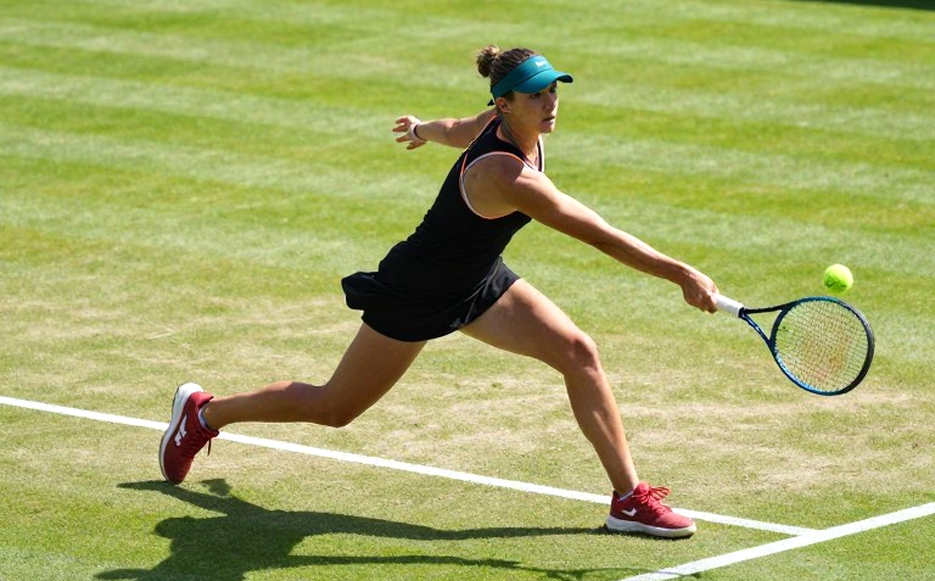
Gauff's competitive identity never actually changed. She is an elite counterpunching, defensive baseliner whose edge is world-class movement and court coverage. The serve was the structural leak in the package, not the package. The article's own “shot of the year” confirms this.
That shot was not a serve. It was a full-court sprint to a short ball, followed by a balanced backhand passing winner. That defensive-to-offensive transition is the essence of her game. She wins with her legs, not with her toss.
The strategic implication is direct: chasing serve reconstruction at the expense of the movement-and-defence base would be an error. The correct read is that the serve only needs to be average-plus for the rest of the package to be top-three.
Now to the most interesting number of the season. Gauff came from behind to win 12 matches in 2026 — tied for the tour lead with Jessica Pegula. The first instinct is to read that as mental steel. It is a double-edged statistic.
Twelve comeback wins can come from two entirely different causes: excellent decision-making under pressure, or chronic slow starts. The available data cannot separate them. Historically, players who lead the tour in comeback wins regress the following season unless the underlying cause is addressed — and a technical cause is fixable while a temperamental one is not.
Ranking structure matters here too. Gauff spent the vast majority of the season in the top five, dropping out briefly after the clay swing and re-entering after the Wimbledon semifinal. That dip reflected a surface transition, not a collapse in form.
Her points base is flat and broad: one WTA 1000 title, two WTA 1000 runner-ups, four Slam or 1000 semifinals. That is not a ranking built on a single tournament spike. It is the healthiest possible composition, because a single early exit does not bring the season down.
Looking ahead, 2027 will bring a heavy and diffuse defence load — Cincinnati, plus the Miami and Rome finals, plus four semifinals. But the 2026 WTA Finals is a pure-upside event for her: she is not the defending champion and carries no defending-champion burden.
Which is where a genuine caution flag appears. Gauff's career record at the WTA Finals is 7-8 across five appearances — well below her overall tour win rate. The arithmetic is suggestive: if the 2026 title run supplied roughly four or five of those seven wins, the other four appearances produced only two or three wins in total.
That is not a coincidence. The round-robin format punishes exactly the profile she has shown — slow starts and high unforced-error variance. Every match counts toward semifinal qualification, so a bad day costs more than it would in a knockout event.
Against that, the form trajectory is the most encouraging signal available. Gauff went through a title-less August, then won Cincinnati, then reached the US Open semifinal. Her peak came in the final third of the season, not the middle. That is the most favourable possible input for a year-end event.
The risks are just as clear. The most effective game plan against her is one that denies her a rally at all: a first-strike, serve-dominant opponent who shortens points and bypasses her defence. In an eight-player field, such opponents are guaranteed.
The second risk sits on the second serve. Double faults cluster where break points cluster, so opponents know exactly where to aim. The third is the forehand: 42 unforced errors in the US Open quarterfinal suggests the secondary pressure point is that wing. Opponents who can extend rallies to it will still find yield — though with low confidence, since stroke-level data is unavailable.
Above all of it sits one conclusion: 2026 was a high-floor, capped-ceiling season. Sixty-two matches, a 75.8 per cent win rate and seven deep runs is title-contender consistency. One trophy from seven opportunities is not.
That is the real story the “weapon” headline obscures. The serve has improved — no player wins a WTA 1000 dropping one set with a genuinely broken serve. But the magnitude and stability of that improvement has not been quantified anywhere. The claim belongs in the category of directionally plausible, quantitatively unproven.
For the WTA Finals, the practical implication is that the condition attached to Gauff is not her serve but her start. If she builds early leads in the group stage and keeps her unforced errors in check, her all-round package can beat anyone. If she slips back into comeback mode, the 12-comeback season will not travel with her — round-robin tennis does not leave that much room.
The balanced verdict, then: Gauff did not fully turn her biggest weakness into a weapon, but she brought it far enough under control that it is no longer the primary obstacle between her and a title. Her real weapon is the one she always had — the running, the defence and the refusal to concede. At the season-ending championships, those three things will decide whether this year ends with a trophy or merely with good numbers.
संबंधित खिलाड़ी
अनुशंसित
Alcaraz and the Davis Cup: Testing 'Career Completion' on an Indoor Hard Court2026-10-24
Wawrinka's Last Backhand: A 24-Year Career Closes in Basel, Three Majors in 33 Months2026-10-29
Rybakina in Ningbo: zero holds in the second set, and an open question before the semi-final2026-10-25
Ningbo's 76 Minutes: Rybakina's Fourth Title Was Built on Serve, Not on Winners2026-10-26
Rybakina Withdraws From Tokyo: A Neck Injury, a Serve Machine, and a Decision Made With the WTA Finals in Mind2026-10-31
अनुशंसित
The 38 Minutes of Ningbo: Rybakina's Title Defence Stood on Her Serve, Not Her Rallies2026-10-26
Wrexham Open Final: Klugman's 6-1 Receipt, Jacquemot's Tiebreak Leak, and the Six Line Items Missing From Every Report2026-10-25
Ningbo Open: Rybakina beats Kawa, but her serve collapsed entirely in the second set2026-10-25
Empty Seats, Missing Minutes: The Part of Tennis the Scoresheet Never Records2026-10-28
Ningbo Final Preview: 11 Set Points, 14 Break Points, and the Real Rybakina–Fernandez Ledger2026-10-25
अनुशंसित
Eleven Set Points and a Love Break: What Rybakina's Ningbo Ledger Says Before the Final2026-10-25
Empty Seats, Missing Minutes: The Part of Tennis the Scoresheet Never Records2026-10-28
Alcaraz and the Davis Cup: Testing 'Career Completion' on an Indoor Hard Court2026-10-24
Rybakina in Ningbo: zero holds in the second set, and an open question before the semi-final2026-10-25
Every Cell N/A: A Void Tennis Analytics Payload That Reports Process, Not Proof2026-10-25
अनुशंसित
Rybakina in Ningbo: zero holds in the second set, and an open question before the semi-final2026-10-25
The Empty Shelf in the Record Room: Where Indian Tennis Lost Its Scorebooks2026-10-24
A Blank Cell, a Full Answer: The Most Honest Line in Tennis Data Is 'N/A — Insufficient Information'2026-10-24
The Interest on the Press: When Mid-Table Sides Start Collecting on Gegenpressing's Debt2026-10-28
Not the Serve, the Legs: Coco Gauff's 2026 Season and the Real Story Before the WTA Finals2026-10-31