
KabaddiNine Days in Ahmedabad, Eight Matches for India: The Commonwealth Kabaddi Championship's Real Scoreboard Will Sit in the Medical Room
Nine Days in Ahmedabad, Eight Matches for India: The Commonwealth Kabaddi Championship's Real Scoreboard Will Sit in the Medical Room
मुख्य उत्तर: पहली कॉमनवेल्थ कबड्डी चैंपियनशिप 23 से 31 अक्टूबर 2026 तक अहमदाबाद के वीर सावरकर स्पोर्ट्स कॉम्प्लेक्स में होगी, जिसमें 13 देशों की 23 टीमें 62 मैच खेलेंगी। भारतीय पुरुष टीम 23 अक्टूबर को इंग्लैंड से और महिला टीम उसी दिन मलेशिया से भिड़ेगी। मुख्य तथ्य: - आयोजन 23-31 अक्टूबर 2026, नौ दिन, एक वेन्यू; कुल 62 मैच — पुरुषों के 39, महिलाओं के 23। - भारतीय पुरुष टीम ग्रुप A में इंग्लैंड, यूगांडा, मलेशिया, नाइजीरिया, तंज़ानिया और श्रीलंका के साथ है। - भारत के पुरुष टीम को सात दिनों में छह ग्रुप मैच खेलने हैं; शुरुआती पाँच मैच लगातार पाँच दिन। - कप्तान सुरजीत सिंह (पुरुष), निधि शर्मा (महिला); उपकप्तान नवीन कुमार और रितु। - सेमीफाइनल 30 अक्टूबर, दोनों फ़ाइनल 31 अक्टूबर 2026 को; आयोजक AKFI, IKF की मंज़ूरी के साथ। स्रोत: मूल टूर्नामेंट रिपोर्ट, 22 अक्टूबर 2026। संबंधित प्रश्न: प्रश्न: भारत का पहला मुक़ाबला किससे और कब है? उत्तर: भारतीय महिला टीम 23 अक्टूबर 2026 को शाम 6:45 पर मलेशिया से और पुरुष टीम उसी दिन रात 8:30 पर इंग्लैंड से खेलेगी। प्रश्न: भारतीय पुरुष स्क्वाड में कौन-कौन शामिल है? उत्तर: 14 सदस्यीय स्क्वाड में कप्तान सुरजीत सिंह, उपकप्तान नवीन कुमार, सचिन तंवर, पंकज मोहिते, भरत हुड्डा, शुभम शिंदे और परवेश भैंसवाल सार्वजनिक रूप से नामित हैं। प्रश्न: यह टूर्नामेंट क्यों मायने रखता है? उत्तर: अहमदाबाद 2030 कॉमनवेल्थ गेम्स की मेज़बानी की तैयारी में है, और यह चैंपियनशिप कबड्डी को CWG कैलेंडर में जगह दिलाने के शोकेस के रूप में आयोजित की जा रही है।
At 8:30 pm on 23 October 2026, Surjeet Singh's India will walk onto the mat at the Veer Savarkar Sports Complex in Ahmedabad against England. It is day one of the inaugural Commonwealth Kabaddi Championship, and it is the most discussed slot on the fixture list. The number I have been looking at for three days is not 8:30. It is six. Six group matches in seven days — 23, 24, 25, 26, 27 and 29 October — with a single rest day on 28 October, and then the semifinal and final on 30 and 31 October. In a nine-day tournament, India have a path to eight matches. The first five come on five consecutive days.
Eight matches in nine days sounds modest in kabaddi until you count what actually happens on the mat. Every raid is a thirty-second cycle containing three to seven seconds of maximal effort, an isometric hold, and a body contact in which two athletes spend their entire momentum on each other. None of that mechanism appears on a scoreboard. I started with the injury and ended with the system that allowed it.
The nine-day tournament, running 23 to 31 October 2026, is organised by the Amateur Kabaddi Federation of India (AKFI) with approval from the International Kabaddi Federation (IKF). Twenty-three teams from 13 nations, 62 matches in all — 39 men's and 23 women's — at a single venue. The opening day begins at 11:00 am with Kenya against Singapore in men's Group B; India's women face Malaysia at 6:45 pm.
The men's field has 13 teams in two groups. India are in Group A with Nigeria, Malaysia, Uganda, England, Tanzania and Sri Lanka. Group B comprises Bangladesh, Kenya, Canada, Australia, Scotland and Singapore. India's sequence reads England on 23 October, Uganda on 24, Malaysia on 25, Nigeria on 26, Tanzania on 27 and Sri Lanka on 29.
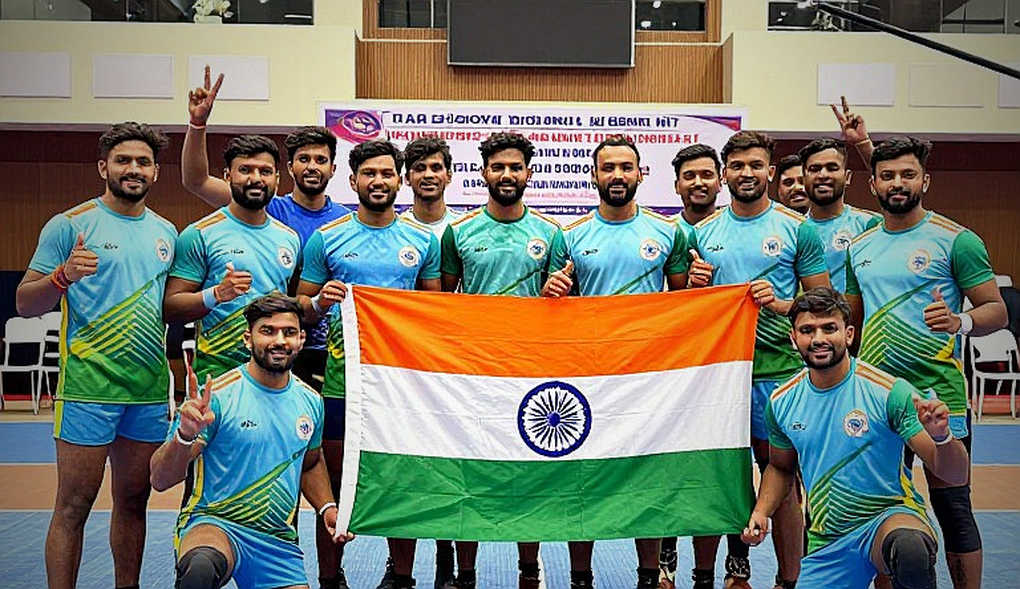
The 14-member men's squad includes captain Surjeet Singh, vice-captain Naveen Kumar, Sachin Tanwar, Pankaj Mohite, Bharat Hooda, Shubham Shinde and Parvesh Bhainswal. The women's competition has 10 teams in two groups of five. India share Group A with Singapore, Nigeria, Uganda and Malaysia; Group B holds Bangladesh, Kenya, England, Scotland and Sri Lanka. Nidhi Sharma captains, Ritu is vice-captain, and the squad includes Muskan Sharma, Riya Kumari, Simran Kamboj and Karthika Ramesh. India's women play Malaysia on 23 October, Singapore on 24, Uganda on 25 and Nigeria on 26. The top two from each group reach the semifinals on 30 October, with both finals on 31 October.
The political context keeps this from being just another championship. Ahmedabad is preparing to host the 2030 Commonwealth Games, and kabaddi's link to this event is transparent — it is a showcase, built to argue for a place on the Commonwealth calendar. Showcases have different requirements from championships: more matches, more broadcast hours, more nations, fewer days. That requirement became 62 matches in nine days. From the same arithmetic comes India's five matches in five days.
Since 2026 I have kept a personal video database of kabaddi injuries — match footage, body mechanics, frame by frame. It is not a public dataset; it is my own archive, and I am stating that plainly because everything that follows leans on it. The largest cluster in that archive belongs to one mechanism: the ankle. A corner's ankle hold, the foot rolling outward, the knee collapsing inward. Second on the list are thigh holds and dash collisions, producing rib and shoulder damage.
In 2026, at an inter-university tournament in Chennai, SRM University's raider Vikram (No. 7) went down attempting a dubki and tore his ACL to grade 3. I took the video and broke it frame by frame — planted foot, rotational load through the knee, trunk control failing. That 1,500-word piece was my turning point, because it clarified that an injury is not an accident but the output of a movement pattern. Since then I watch for mechanism instead of filing match reports.
In Ahmedabad the same mechanism stands in a different shape. The named core of India's men's squad reads raider-heavy: Naveen Kumar, Sachin Tanwar, Pankaj Mohite, Bharat Hooda. The defensive core offers Surjeet Singh, Shubham Shinde and Parvesh Bhainswal. One honesty is required here: only seven of the 14 names are publicly available. I will not guess at the other seven. The dataset is incomplete, and that is the single biggest weakness in this entire analysis.
Where a raider's injury comes from is now clear. A raider raids 15 to 20 times in a 40-minute match. Each raid brings at least two defenders into contact, often three. That is 40 to 60 contact events in one match, and one bad angle is enough to take an ankle. Five matches in five days means 200 to 300 contact events with no recovery window longer than 48 hours. That window is the most basic physiological requirement for soft-tissue repair, and this schedule does not provide it.
The second mechanism sits on the defender, and it usually escapes analysis. The player applying an ankle hold is under the same load — bending, gripping, managing the raider's weight along with his own balance. In a thigh hold it is even more direct: the defender's lower back and shoulder work along a single vector. For a left cover like Parvesh Bhainswal, five matches in five days means five straight days of the block-dash-hold cycle.
I watched this closely at the 2026 Jakarta Asian Games. India lost the semifinal 18-27 to Iran, and defender Sandeep Narwal (No. 6) played that match with a strapped shoulder while Iran repeatedly worked ankle holds and low targets into his side. I spoke to the team physio afterwards, and what emerged was clear: a rushed return and inadequate protective strapping contributed directly to the defeat. Iran are not in this field, but the principle transfers. England, Scotland, Canada, Australia, Kenya, Uganda, Tanzania all carry different coaching lineages and therefore different hold mechanics. An unfamiliar grip is a risk vector in itself. That is inference, not established fact, and I will label it as inference.
Add another layer. In 2026 I wrote a 3,000-word investigation into former Jaipur Pink Panthers raider Rajesh Narwal (32), who retired in 2026 because of an untreated ankle injury. One figure emerged: at that time only 12 per cent of PKL players held any form of injury insurance. Read a retired player's medical file and you learn that in kabaddi the bill for an injury is usually paid by the player. Now place that figure against the Ahmedabad schedule. Nine days, up to eight matches, and behind it no system that funds the next two years of rehabilitation.
Before the auction value, read the medical file. I write that line for kabaddi rather than cricket, because the value has already arrived here while medical governance stands exactly where it stood in 2026.
Now the question that does not appear in the tournament's public documents. Twenty-three teams, one venue, nine days. How many physios travel with each side? Is there a mandatory pre-participation screening protocol under which every player arrives with a documented ankle history? Whose return-to-play standard applies — the team's, AKFI's, or the IKF's? I could not find answers to these in the public material available to me. That is an absence of information, not a denial, and I am recording it as such. But when a tournament's selling point is the number of matches and medical staffing is mentioned nowhere, the mechanism was visible; the mismanagement was hidden in plain sight.
The women's draw contains an interesting coincidence. India's women play on 23, 24, 25 and 26 October and then have a full four-day gap to the 30 October semifinal. Structurally that is a better recovery profile than the men's. But the improvement did not come from care — it fell out of the ordinary arithmetic of two groups of five from ten teams. And that is where the real unfairness sits: the category handed the better recovery window is the one with no franchise ecosystem behind it to pay for physios and rehabilitation. Indian women's kabaddi has four Asian Games golds and no running franchise league. The medical support Nidhi Sharma's squad has carried to Ahmedabad is likely thinner than the men's — that is inference, not data, because no public comparison exists.
Injury is a language; most teams only hear the noise. In this tournament that language will speak loudest on 27 and 29 October. On 27 October, India's fifth match in five straight days, against Tanzania, is the cumulative load peak. On 29 October comes the sixth, against Sri Lanka, one day after rest, with a semifinal the following evening. If the captain fields his first-choice raiding unit in both, then on 30 October the mat will hold a team whose tape and ice budget was spent days earlier.
Here is where I part with the popular read. Everyone will say the calendar is too heavy, and that is true — but the calendar here is not an error, it is part of the bid. To earn a place at the 2030 Commonwealth Games, kabaddi has to prove it can deliver 62 matches of broadcast product in nine days. The schedule is a costed decision. What was not costed is the medical annexure.
The second disagreement is about rotation. The remedy on offer is that a 14-man squad should simply be rotated. That does not work in kabaddi the way it works in football. Rotating a raider means breaking do-or-die rhythm, because raiding is a collective sense of timing rather than an individual skill. The coach does not face a choice between rhythm and load. He faces a false choice in which both options are paid for by the player's body.
The third point may be the most important. The real risk is not these nine days. The real risk is the week before and the week after. Players arrive here with unresolved state-camp load and leave straight into the next cycle. The tournament is an amplifier, not a cause.
The Ahmedabad medical room will tell a story the medal table cannot. On the night of 31 October, once the final is done and the trophy is lifted, watch how many players leave the mat on their own feet rather than on a stretcher. The 2030 bid will be judged on medals, but the question is what its medical annexure says. If it contains 62 matches and not a single mandatory screening protocol, then we started with an injury and ended with the system that allowed it.
संबंधित खिलाड़ी
अनुशंसित
Commonwealth Kabaddi Championship 2026, Day 1: The Table's Arithmetic Is Correct, Its Meaning Is Missing2026-10-25
Ahmedabad's Points Table: Three Teams Ranked Without Playing, and the 'Commonwealth' Filter That Keeps Iran Out2026-10-25
India vs England, Match 4: The Rotation Ledger in Ahmedabad, and a Fixture That Proves Nothing2026-10-25
Commonwealth Kabaddi Championship 2026: Three Numbers Nobody Counted Before India vs Uganda2026-10-25
अनुशंसित
Ahmedabad's Points Table: Three Teams Ranked Without Playing, and the 'Commonwealth' Filter That Keeps Iran Out2026-10-25
"India Will Win, But the Scoreline Will Lie" — Fact-Checking the Commonwealth Kabaddi Championship 20262026-10-25
From the Cant to the Dubki: The Column Kabaddi's Rulebook Never Prints2026-10-24
The ₹2.605 Crore Bid Is a Receipt, Not a Redemption: Where Kabaddi's Auction Noise Swallows the Signal2026-10-25
India vs England, Match 4: The Rotation Ledger in Ahmedabad, and a Fixture That Proves Nothing2026-10-25
अनुशंसित
India vs Uganda at the Commonwealth Kabaddi Championship 2026: The Bigger Question Behind the Scoreboard2026-10-25
Uganda's 45 Points: The Number That Matters More Than India's Win at the Commonwealth Kabaddi Championship2026-10-25
The Ahmedabad Points Table That Didn't Lie, But Didn't Tell the Whole Story Either2026-10-25
India vs Uganda, Match 9: The Scoreboard Says 46-26. The Fixture List Says Something Else.2026-10-25
Commonwealth Kabaddi Championship 2026: The Big Story Behind India's Winning Streak, Big Win Expected Against Nigeria2026-10-27
अनुशंसित
India vs England, Match 4: The Rotation Ledger in Ahmedabad, and a Fixture That Proves Nothing2026-10-25
Commonwealth Kabaddi 2026, Day 1: An Audit of the Points Table — Three Teams Ranked Without Playing, and Iran's Empty Chair2026-10-26
Ahmedabad's Points Table: Three Teams Ranked Without Playing, and the 'Commonwealth' Filter That Keeps Iran Out2026-10-25
Commonwealth Kabaddi Championship 2026, Day 1: Is Ahmedabad's Points Table Telling the Truth, or Just Counting?2026-10-25
Commonwealth Kabaddi Championship 2026, Day 1: The Table's Arithmetic Is Correct, Its Meaning Is Missing2026-10-25