
Kabaddi: From the Clay Akhara to the Broadcast Studio
कबड्डी भारत का पारंपरिक संपर्क खेल है जिसे 1990 बीजिंग एशियाई खेलों में पदक वाला दर्जा मिला। 2014 में प्रो कबड्डी लीग की शुरुआत ने खेल को मिट्टी के अखाड़े से सिंथेटिक मैट और टेलीविज़न ब्रॉडकास्ट तक पहुँचाया, जिससे फ्रैंचाइज़ी मॉडल, खिलाड़ी नीलामी और डेटा-आधारित रणनीति का युग शुरू हुआ। खेल का मूल नियम है — रेडर को एक साँस में लगातार 'कबड्डी' कहते हुए विपक्षी आधे हिस्से में जाकर टच अंक लेने और लौटना होता है। आधुनिक रूप में तीस सेकंड का रेड क्लॉक, डू-ऑर-डाई रेड, बोनस लाइन और सुपर टैकल जैसे नियम लागू हैं। महिला कबड्डी 2010 ग्वांगझोउ एशियाई खेलों से पदक वाला खेल है और भारतीय टीम मजबूत रही है, लेकिन स्थायी पूर्ण-सत्र महिला लीग का अभाव प्रमुख चुनौती है। अंतरराष्ट्रीय स्तर पर ईरान सबसे मजबूत प्रतिद्वंद्वी उभरा है, और 2016 विश्व कप का फाइनल भारत और ईरान के बीच खेला गया था। कबड्डी अभी ओलिंपिक कार्यक्रम का हिस्सा नहीं है।
On the outskirts of almost any Indian village, in a field left empty after the harvest, a winter morning repeats the same scene. Twenty or thirty pairs of eyes stand in a circle; in the middle a young man takes a deep breath, fills his lungs, and breaks into a run. From his mouth comes one word, unbroken, unstoppable — kabaddi, kabaddi, kabaddi. The circle closes in, hands reach out, legs spread wide, and if that word cracks for even a moment, he is out. That is the rule, that is the entire game, and that is its oldest identity.
There is no scoreboard in this scene, no camera, no commentator, no coach studying numbers on a tablet. Yet a sport that was confined to this form a few decades ago now sits at the centre of a league whose broadcast graphics, auction bids and data-driven team strategies look no different from those of a major cricket tournament. Kabaddi's story is not merely the story of a sport becoming popular; it is the story of an ecosystem being built that turned a player raised on a village field into a face on national television — and in the process changed the game's rules, its speed, its injury profile and its economics.
Kabaddi's roots run deep, but its history is more spoken than written. The Mahabharata's chakravyuh and the story of Abhimanyu are often linked to an ancient form of the game, though this is a cultural association rather than a documented fact. What is less disputed is that nearly every region of India had some local form of the sport — hu-tu-tu in Maharashtra, kaudi in Punjab, sadugudu in Tamil Nadu, soo-choo in eastern India, and in many places sanjeevani, in which holding one's breath was compulsory. Said to have been part of soldiers' physical training in the Maratha era, the game began to organise itself in the early twentieth century. A first systematic draft of rules was prepared in 2026, and at the 2026 Berlin Olympics it was demonstrated by the Hanuman Vyayam Prasarak Mandal of Amravati — a moment often treated as kabaddi's first appearance on an international stage. It was made a medal sport at the 2026 Beijing Asian Games, and for several editions after that the Indian men's team's dominance was such that gold was treated as pre-decided.
The real earthquake came in 2026. With the launch of the Pro Kabaddi League, the sport was lifted off clay and placed on a synthetic mat, redesigned for television, and its teams sold on a franchise model. A player who until yesterday competed in state-level tournaments at his own expense suddenly became the subject of bidding at an auction. This change was not only financial. On the mat the game became faster, injuries changed, tackling changed, and strategy shifted from individual skill to collective arithmetic.
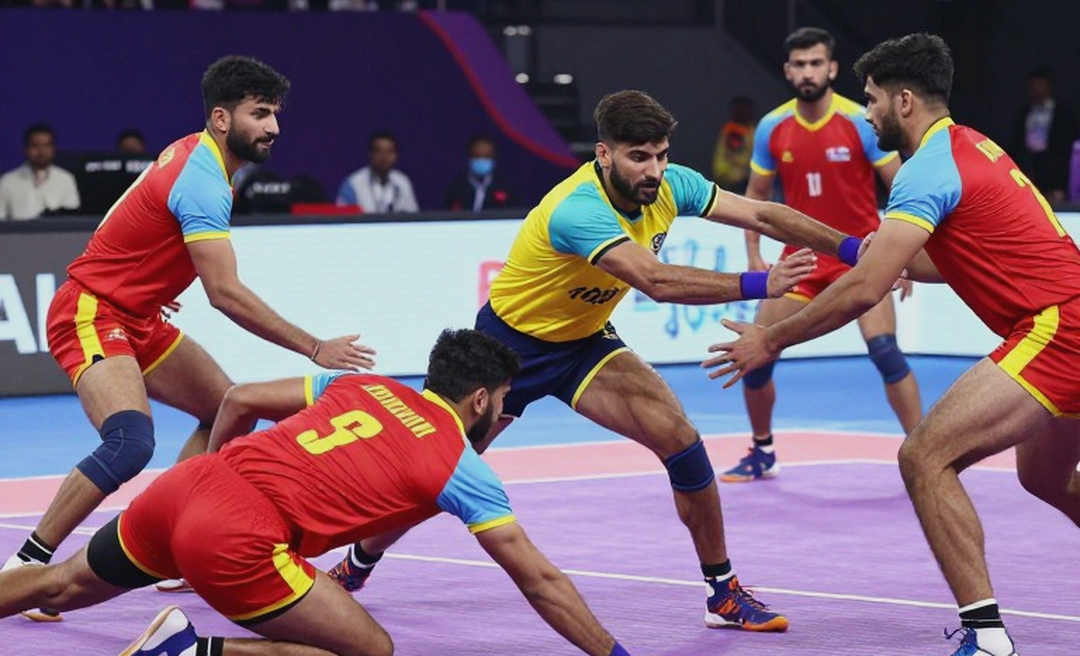
Raiding — the attacker's solo incursion into the opposition half — is the most dramatic part of the sport and also the most technical. A raider has thirty seconds, one breath and very little space. He has several tools for the touch: brushing past with a toe, a long reach of the arm, a back kick, the dubki — ducking through a gap between defenders — or pushing through a wall of defenders to cross the bonus line. The dubki is generally credited with being popularised by Pardeep Narwal, known for that very reason as the Dubki King; Rahul Chaudhari was long known for his speed and long touch, while raiders such as Anup Kumar and Ajay Thakur gave the game a different, calmer, more calculating style. But modern raiding now involves not only skill but pattern recognition of the opposing defence: which corner dips and when, when the cover advances, when the chain breaks — all of this has become the subject of video analysis.
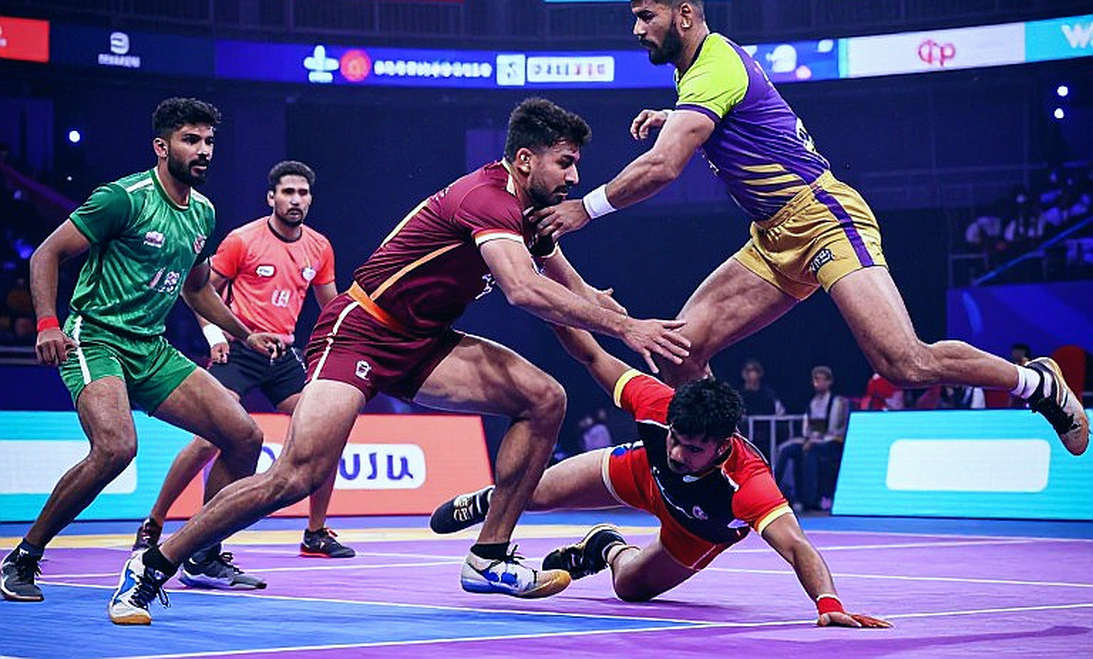
Defence is equally important and considerably riskier. Ankle holds, thigh holds, waist holds, blocks, dashes and chain tackles — every technique puts both full body weight and the opponent's momentum at stake. A dash mistimed can concede two points, and a well-timed chain tackle becomes a three-point super tackle. The corner defender's job is considered the hardest, because he must simultaneously stop the raider and watch his own boundary line. Iranian defenders such as Fazel Atrachali have shown that in this sport foreign players are not merely participants but can be the spine of a team.
The evolution of the rules is the least discussed link in this transformation. The thirty-second raid clock, the introduction of the do-or-die raid, the bonus line, points awarded for an all-out, the review system — each of these changes made the game faster and more legible for television. Coming onto the mat increased the game's speed, but also the risk of slipping and the load on the knees. On the old clay akhara a player moved more slowly and falling involved more friction; on the mat the speed is higher, the frequency of direction changes greater, and that is why inversion injuries of the ankle, knee ligament problems and shoulders popping out in tackles have become common. This has forced teams towards physios, strength and conditioning coaches and recovery protocols — a professional structure that was almost absent from the sport a decade ago.
Women's kabaddi is the most contradictory chapter of this story. Women's kabaddi was given medal status at the 2026 Guangzhou Asian Games and the Indian team maintained dominance from there on. At state level, girls enter the sport in large numbers, and their participation in school and university competitions is not small. But when it comes to a major television product, franchises and salaries, women's kabaddi has not received the space the men's league occupies. In some seasons there were women's exhibition matches, some small leagues were formed, but the absence of a permanent, full-season women's league remains the biggest uncertainty in players' careers. This gap must be seen not merely as a social issue but as a question of economic investment.
At the grassroots, the picture is honest from both sides. On one hand, rural summer and winter tournaments are still held with the same enthusiasm in dozens of districts, where the prize is sometimes cash, sometimes a goat or a blanket, and the crowd runs into the thousands. On the other, a player emerging from this same grassroots still has no reliable route back through schooling, job security and post-injury recovery. Academies have grown, and programmes such as Khelo India have opened a path to recognition and scholarships, but questions remain over the transparency of selection and regional balance.
On the economic side, the biggest change is that the sport is no longer only played but also sold. Franchise owners, broadcasters, sponsors and player agents all work on the same timeline, and their interests also collide. Decisions such as the auction date, player retention rules and season length directly determine a player's income and the burden placed on his body. The return of spectators in post-Covid seasons proved that the sport's popularity was not limited to television, but it also showed that ticketing, the stadium experience and engagement with the local community are still not as strong as broadcast revenue.
Internationally, kabaddi is no longer a one-country sport. Iran is the clearest example — it has won gold at the Asian Games and its players are counted among the most reliable members of Indian league teams. Organised kabaddi federations are also active in countries such as Bangladesh, South Korea, Kenya, Poland, Argentina and England. The 2026 World Cup, held in Ahmedabad, in which India beat Iran in the final, was a solid sample of this expansion. But the international calendar remains fragmented — the league, the Asian Games, the World Cup and regional competitions do not move in coordination, and the direct cost is borne by player availability and injury management.
The list of challenges is long, and none of them alone is the death of the sport, but together they will decide its direction. The season calendar is congested and players face constant pressure to play. Umpiring consistency is debated every season, especially over hand and foot position during tackles and decisions on the boundary line. Threats such as betting and spot-fixing require a strong monitoring mechanism, because in a sport where a single point carries heavy weight, one suspicious decision can affect the credibility of an entire season. And the biggest structural gap is that kabaddi has no Olympic pathway — its place at the Asian Games is secure, but inclusion in the Olympic programme requires global participation, uniform rules and a stable international calendar, and all three remain incomplete.
Amid all this, one thing has not changed. If you walk into any field anywhere in the country on any evening, you will find the same scene — a young man, a deep breath, and one word moving without pause. Television has adorned that scene with lights, graphics and money, but the essence of the game lives in that one breath. Kabaddi's real strength is that it places even its biggest star under the same rule as the unnamed player on a village field — if the breath breaks, you are out. Whether the next stop for a sport that has travelled so far on so few resources should be the Olympics is open to debate; but it is certain that it can no longer return to the clay akhara it came from — and perhaps it should not.
संबंधित खिलाड़ी
अनुशंसित
Commonwealth Kabaddi Championship 2026, Day 1: The Points Table Isn't Lying, But It Isn't Telling the Whole Truth Either2026-10-25
The ₹2.605 Crore Bid Is a Receipt, Not a Redemption: Where Kabaddi's Auction Noise Swallows the Signal2026-10-25
Commonwealth Kabaddi Championship 2026, Day 1: The Table's Arithmetic Is Correct, Its Meaning Is Missing2026-10-25
Uganda's 45 Points: The Number That Matters More Than India's Win at the Commonwealth Kabaddi Championship2026-10-25
"India Will Win, But the Scoreline Will Lie" — Fact-Checking the Commonwealth Kabaddi Championship 20262026-10-25
अनुशंसित
Kabaddi: From the Clay Akhara to the Broadcast Studio2026-10-31
Ahmedabad's Points Table: Three Teams Ranked Without Playing, and the 'Commonwealth' Filter That Keeps Iran Out2026-10-25
The Ahmedabad Points Table: Five Matches, Thirteen Teams, and a Count That Does Not Reconcile2026-10-25
Commonwealth Kabaddi 2026, Day 1: An Audit of the Points Table — Three Teams Ranked Without Playing, and Iran's Empty Chair2026-10-26
अनुशंसित
Ahmedabad's Points Table: Three Teams Ranked Without Playing, and the 'Commonwealth' Filter That Keeps Iran Out2026-10-25
The Scorecard Isn't Lying, It's Incomplete: An Audit of Kabaddi's Official Memory2026-10-29
Kabaddi: From the Clay Akhara to the Broadcast Studio2026-10-31
Commonwealth Kabaddi 2026, Day 1: An Audit of the Points Table — Three Teams Ranked Without Playing, and Iran's Empty Chair2026-10-26
अनुशंसित
India vs England, Match 4: The Rotation Ledger in Ahmedabad, and a Fixture That Proves Nothing2026-10-25
The Ahmedabad Points Table: Five Matches, Thirteen Teams, and a Count That Does Not Reconcile2026-10-25
Commonwealth Kabaddi Championship 2026: Three Numbers Nobody Counted Before India vs Uganda2026-10-25
Commonwealth Kabaddi Championship 2026, Day 1: The Table's Arithmetic Is Correct, Its Meaning Is Missing2026-10-25
Kabaddi: From the Clay Akhara to the Broadcast Studio2026-10-31