
Kabaddi's Second Decade: From the Clay Court to the Broadcast Studio
**सार:** कबड्डी के पास अपार जन-आधार है, लेकिन उसका पेशेवर ढाँचा अभी आंशिक है। फ्रैंचाइज़ी लीग ने दृश्यता और आय बढ़ाई, पर ग्रामीण और स्कूली आपूर्ति श्रृंखला, खिलाड़ी सामाजिक सुरक्षा, महिला कबड्डी का ढाँचा और राज्य-स्तरीय व्यवस्था पीछे रह गई। **मुख्य बिंदु:** (1) खेल का तकनीकी आधार — रेड, साँस का नियम, डिफेंस का योजनाबद्ध होना — अब विश्लेषण-आधारित कोचिंग मांगता है। (2) लीग का सत्र छोटा होने से खिलाड़ी का करियर मौसमी बना हुआ है। (3) ग्रामीण प्रतियोगिताओं में वेतन, बीमा और पोषण का अभाव प्रतिभा-क्षरण का मुख्य कारण है। (4) ईरान जैसी टीमों की प्रगति संगठन-आधारित है, केवल प्रतिभा-आधारित नहीं। (5) महिला कबड्डी में निवेश बढ़ाना आर्थिक विस्तार है, केवल सामाजिक दायित्व नहीं। **निष्कर्ष:** अगले दशक में कबड्डी की सफलता इस पर निर्भर है कि लीग, संघ और राज्य तंत्र खेल के आधार के विकास का खर्च स्पष्ट रूप से बाँटें — अन्यथा दृश्यता बढ़ेगी और प्रतिभा-पूल सिकुड़ेगा।
Kabaddi is often dismissed as a simple game. Seven players, one raid, thirty seconds, and a single breath while repeating "kabaddi-kabaddi" continuously — from the outside it all appears informal, almost like a neighbourhood pastime. Stand at the edge of the mat, however, and the character of the sport changes. Within a single thirty-second raid, the raider must make three separate decisions in sequence: when to enter the opponents' half, which defender to pressure, and when to return. One wrong step does not merely cost a point — the raider is out, and the entire team is placed under pressure.
The biggest paradox of this sport has always been that the number of people who play it has consistently exceeded the number who watch it. Across the villages, small towns and school grounds of the Indian subcontinent, kabaddi was never counted as a "sport" at all — it was a collective evening ritual with no coach, no referee, and a win or loss forgotten by the next morning. On the scale of professional sport, this is an inconvenient inheritance: a game with roots that deep cannot be moved from the field to the stadium by money alone. It requires an entire administrative structure.
Over the past decade, kabaddi has partially acquired that structure. The word "partially" is deliberate. The franchise league brought the sport to television, gave players incomes their fathers could not have imagined, and connected kabaddi to an audience that was prepared to watch something other than cricket. But in that process, a large part of the game — rural competitions, the school level, and the domestic systems of the states that produce players — was left behind. This report examines that dual character: where kabaddi has arrived, and where it must now fight its own success in order to arrive.
None of this debate makes sense without understanding the technical framework of the sport. A kabaddi court is rectangular, with a raid boundary at each end and a full court in between. The raider must enter the opponents' half and return to their own — all in one breath, while continuously uttering the word. The breaking of the breath ends the raid. This rule binds the sport to a strange physical limit: a raider's capacity depends less on muscle and more on lung function.
In the modern mat version, the pace has increased considerably. On clay, a raider needed grip on the ground to control his footwork; on the mat, friction is lower, the turning radius has shrunk, and the time available to a defender to react has compressed. This shift has split the strategy of the game into two halves — raiding and defence — and turned both into areas of specialist expertise. The player who could once do both is now called an "all-rounder" and has become the most expensive resource on a team.
The transformation of defence is perhaps the least discussed and most important change. In traditional kabaddi, a defender's job was to catch the raider — a reactive role. Today, defence is an active plan: the arrangement of covers, corners and chains is decided in advance, and the raider is drawn into a pre-designed trap. A defender no longer watches the direction of the raider's foot but the raider's habits. This change has made the sport analytical — and this is where video analysis, the role of statistics and the size of coaching staffs begin to grow.
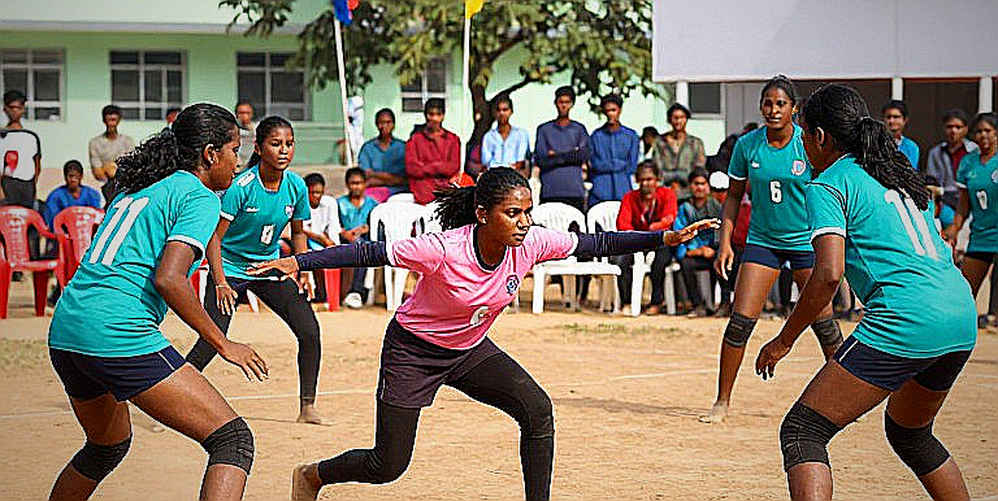
But the foundation of all this technical progress remains the same old supply chain that nobody measures. In India, the first tier of kabaddi is the village and small-town ground. From there a player moves to district-level competitions, then to the state level, and after that — if they are fortunate — to a league auction. The greatest weakness of this chain is that it contains no money. Rural tournaments run on contributions from temple committees, panchayats or local traders. Players receive no salary, no insurance against injury, no provision for nutrition. A player who returns injured often leaves the sport altogether — and their name is recorded nowhere.
This is precisely where the economic model of the league begins to show its limit. The entire logic of the franchise system is that private capital will bring the sport to the market and the market will sustain the sport. But the market invests in what is visible. The league is built for television, so its attention is on teams, branding and the match-day experience. The base of the game — where players come from — is not a cost line on the league's balance sheet but an external assumption. In the long run, this gap is dangerous. A league can run for the next five years on the strength of existing players; to run for the next fifteen, it will need a continuous supply of new ones, and those new players will come from the same soil that the league has never treated as its responsibility.
The league's second structural problem cannot be ignored either. The season is short and the number of matches limited. This means a player's professional workload for the year is compressed into a few weeks. What does he do in the remaining months? Some players go to other leagues or foreign competitions, some look for government jobs, some turn to coaching. This "two-season" economy makes a player's career uncertain and weakens their professional identity. A cricketer remains a cricketer all year; a kabaddi player is a "former kabaddi player" for most months of the year.
The role of states and federations is decisive in this context, but its form is old. In many states, the support that comes from the sports department is on paper — poor ground conditions, irregular coach appointments, and seasonal training camps. Players receive job reservations, and this system genuinely allows many families to stay in the sport. But this system prevents players from leaving the game; it does not improve their performance. These are two different things. A player continuing to play because of a job is good; but the training system required to make them among the best in the world is not built by a job guarantee.
Internationally, the kabaddi landscape has changed in an interesting way, and that change is also a warning for India. The Iranian team has emerged over recent years as a disciplined, physically strong and tactically composed unit. Its strength lies less in technical innovation and more in system — a centralised training structure, long camps, and clearly defined roles. India has always had depth of talent, but depth and system are two different qualities. When a rival advances through system and you rely on talent, the gap widens slowly and then appears suddenly.
Women's kabaddi is the brightest and least invested part of this entire picture. Women players have performed consistently well in international competitions, but the media coverage, sponsorship and domestic infrastructure available to them are far smaller than in the men's game. This gap is not merely a question of justice; it is a direct economic loss for the sport. In a game where half the supply of talent comes from half the population, building a separate league, separate training and a separate audience market for that half is not an expense but an expansion.
The way forward runs through three clear priorities. First, improving the base of the game: providing mats, coaches and medical facilities at school and block level, so that a player's identity is recorded before their injury is. Second, securing year-round income and social protection for players, so that the sport becomes a career rather than a seasonal favour. Third — and this is the hardest — a clear division of accountability between the league and the federation, in which it is settled who bears the cost of developing the sport.
Kabaddi's greatest strength and greatest weakness are the same thing: its ease. That ease embedded it in the bodies of millions, but the same ease also gave it the belief that it needed no formal system. Now that the sport has arrived on the mat, on television and at the auction table, that belief has become a risk. The next decade will determine whether kabaddi remains a popular event, or becomes a professional sport whose roots are stronger than its own success.

संबंधित खिलाड़ी
अनुशंसित
The Ahmedabad Points Table: Five Matches, Thirteen Teams, and a Count That Does Not Reconcile2026-10-25
The ₹2.605 Crore Bid Is a Receipt, Not a Redemption: Where Kabaddi's Auction Noise Swallows the Signal2026-10-25
India vs Uganda at the Commonwealth Kabaddi Championship 2026: The Bigger Question Behind the Scoreboard2026-10-25
Kabaddi's Second Decade: From the Clay Court to the Broadcast Studio2026-10-31
From the Cant to the Dubki: The Column Kabaddi's Rulebook Never Prints2026-10-24
अनुशंसित
The Truth of the Third Raid: In Kabaddi, the Stand Speaks Before the Scoreboard2026-10-25
Commonwealth Kabaddi Championship 2026, Day 1: The Points Table Isn't Lying, But It Isn't Telling the Whole Truth Either2026-10-25
Commonwealth Kabaddi Championship 2026, Day 1: The Table's Arithmetic Is Correct, Its Meaning Is Missing2026-10-25
"India Will Win, But the Scoreline Will Lie" — Fact-Checking the Commonwealth Kabaddi Championship 20262026-10-25
India vs Uganda at the Commonwealth Kabaddi Championship 2026: The Bigger Question Behind the Scoreboard2026-10-25
अनुशंसित
The ₹2.605 Crore Bid Is a Receipt, Not a Redemption: Where Kabaddi's Auction Noise Swallows the Signal2026-10-25
Commonwealth Kabaddi Championship 2026, Day 1: The Table's Arithmetic Is Correct, Its Meaning Is Missing2026-10-25
The Ahmedabad Points Table: Five Matches, Thirteen Teams, and a Count That Does Not Reconcile2026-10-25
Commonwealth Kabaddi Championship 2026, Day 1: The Points Table Isn't Lying, But It Isn't Telling the Whole Truth Either2026-10-25
India vs Uganda, Match 9: The Scoreboard Says 46-26. The Fixture List Says Something Else.2026-10-25