
Inaugural Commonwealth Kabaddi Championship in Ahmedabad: The Real Test Before 2030 Is Event Credibility
मुख्य उत्तर: पहली कॉमनवेल्थ कबड्डी चैंपियनशिप 23 अक्टूबर 2026 से अहमदाबाद में शुरू होगी और 13 देशों के बीच नौ दिनों में 62 मुकाबले कराए जाएंगे; आयोजन की विश्वसनीयता महिला भागीदारी और पंजीकृत आंकड़ों की स्पष्टता पर निर्भर करेगी। मुख्य तथ्य: - आयोजन की तारीख: 23 से 31 अक्टूबर 2026; सेमीफाइनल 30 अक्टूबर और फाइनल 31 अक्टूबर। - कुल कार्यक्रम: 62 मैच; 39 पुरुष और 23 महिला मुकाबले। - भागीदारी: 13 देश और 400 से अधिक खिलाड़ियों की रिपोर्ट। - प्रारूप-संकेत: 39 पुरुष मैच 13 टीमों के दो समूहों से मेल खाते हैं; 23 महिला मैच लगभग 10 टीमों का संकेत देते हैं। - भारतीय कप्तान: पुरुष वर्ग में सुरजीत सिंह; उपकप्तान नवीन कुमार; महिला वर्ग में निधि शर्मा और रितु। स्रोत: “Ahmedabad hosts first Commonwealth Kabaddi Championship, with CWG 2030 inclusion in sight”, 21 अक्टूबर 2026; उपलब्ध विश्लेषण के आधार पर। संबंधित प्रश्न: प्रश्न: प्रतियोगिता किस नियम शैली में होने की संभावना है? उत्तर: आयताकार कोर्ट और आईकेएफ स्वीकृति के आधार पर यह स्टैंडर्ड स्टाइल कबड्डी होने की संभावना है, हालांकि आधिकारिक घोषणा में शैली स्पष्ट नहीं की गई है। प्रश्न: 23 महिला मैचों का क्या संकेत है? उत्तर: मैच-गणित लगभग 10 महिला टीमों की ओर संकेत करता है, इसलिए संभव है कि 13 में से करीब तीन देशों ने महिला टीम नहीं भेजी हो। प्रश्न: भारत के लिए निर्णायक चरण कौन-सा होगा? उत्तर: ग्रुप चरण के बजाय 30 अक्टूबर के सेमीफाइनल में उच्च स्तरीय डिफेंस के खिलाफ भारत की रेडिंग और रोटेशन असली परीक्षा होगी।
Hook: The First Audit Before the Opening Raid
The inaugural Commonwealth Kabaddi Championship, scheduled to begin in Ahmedabad on October 23, 2026, is being presented as an early piece of evidence for kabaddi's possible inclusion in the 2030 Commonwealth Games. On paper, the event is substantial: 13 countries, nine days, 62 matches, 39 in the men's competition and 23 in the women's competition. The semifinals are scheduled for October 30, with both finals on October 31.
The most important figure before the opening raid, however, is the one that is not yet fully clear. The reference to 13 countries and more than 400 players does not directly reconcile with 23 women's matches. If the men's draw has 13 teams split into groups of seven and six, a round-robin stage followed by two semifinals and a final produces exactly 39 matches. The same arithmetic for 23 women's matches points to roughly 10 teams split into two groups of five. That suggests approximately three of the 13 countries may not be entering women's teams.
This is not a minor technical discrepancy. If the championship is intended to establish kabaddi as a credible Commonwealth sport for 2030, its participation, gender balance and match structure must be transparent in the same document. Branding comes after the record is reconciled.
Context: Standardised Rules, Unequal Ground
The tournament is being organised by the Amateur Kabaddi Federation of India with the approval of the International Kabaddi Federation. The available information does not explicitly name the style, but the 13-metre by 10-metre rectangular court, seven-player teams, 30-second raids and international rules strongly indicate Standard Style kabaddi. Circle Style, popular in Punjab's festival circuit, operates on a different field and competitive structure. Treating the two as interchangeable would be the first reporting error.
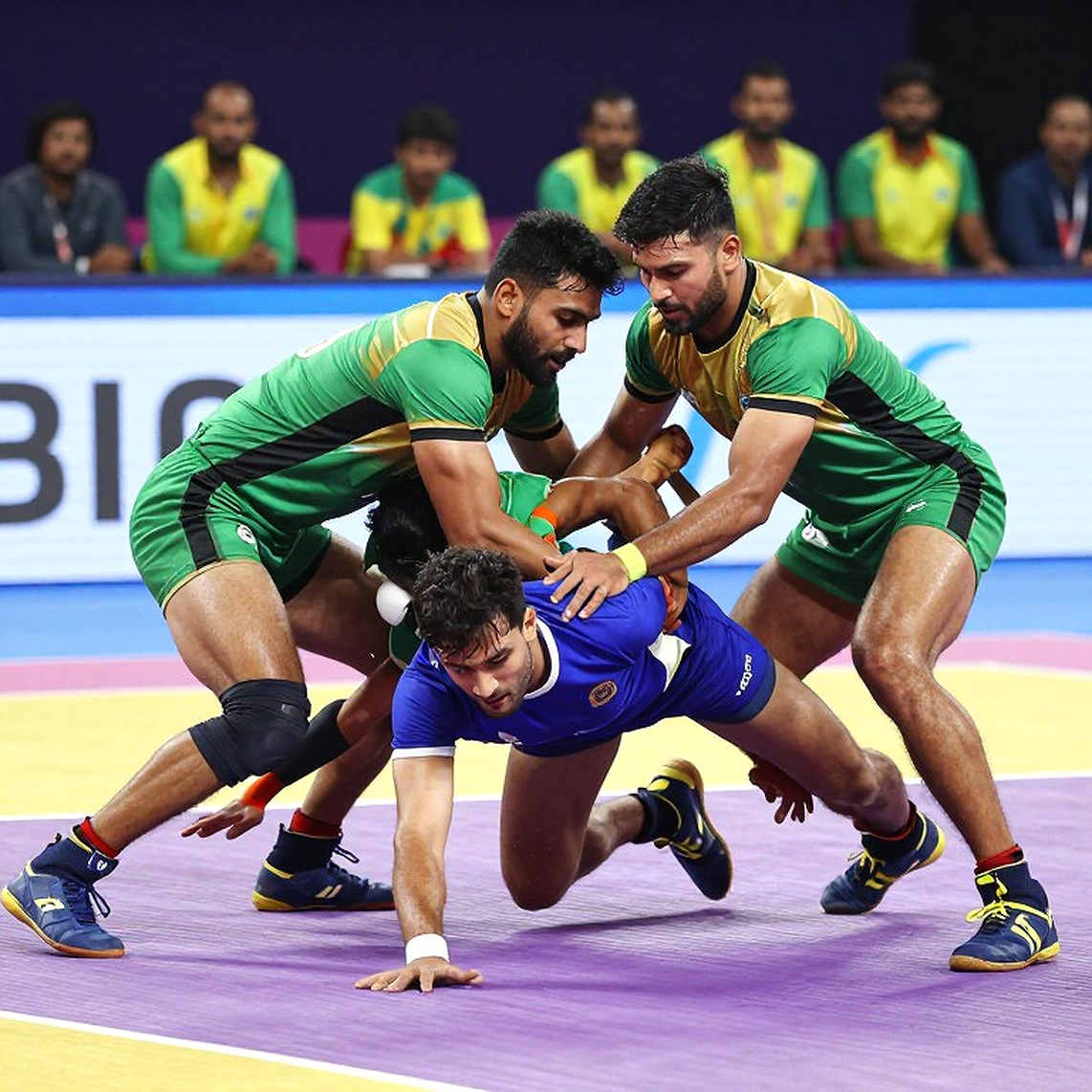
Kabaddi's basic rule is easy to understand, although its competitive arithmetic is not. A raider enters the opposition half while continuously chanting “kabaddi,” attempts to touch a defender and returns safely. A successful touch produces a point. If the defence stops the raider, it scores a tackle point. Crossing the bonus line produces one point when the defending team has six or more players on court. When every player on one side is out, the opposition receives two additional points and the team is revived. After two consecutive empty raids, the third becomes a do-or-die raid; failure to score sends the raider out.
These rules will shape the tournament's likely pattern. For a strong team, the bonus line offers a low-risk source of points against passive defence. The do-or-die rule prevents weaker sides from using repeated empty raids simply to consume time. The result should be a faster competition, but it may also reduce the room for upsets between established teams and developing programmes.
The IKF and Pro Kabaddi League rule environment gives Indian players a familiar competitive language. That familiarity is an advantage for India and a challenge for the tournament. India's top structure is supported by domestic league exposure, national camps and international experience. Several other countries may still be behind in player availability, travel, preparation and match rhythm. Standardisation does not erase that gap; it makes the gap more visible.
Core Analysis: The Event, More Than India, Is Under Examination
For India, the most rational use of the group stage will be rotation and workload management rather than simply chasing the biggest possible margins. Sixty-two matches across nine days means an average of about seven matches per day. The schedule is workable if multiple courts are used, but the quality of travel, warm-ups, recovery and medical support will matter. Developing teams may have limited sports-science resources. In that setting, soft-tissue injuries become an organisational issue as well as a medical one.
India's real selection test will arrive in the semifinals, when its strongest combinations and regular core players are likely to receive longer minutes. A wide group-stage win may demonstrate attacking superiority, but it will not measure decision-making against a high-level defence. Reaching the bonus line repeatedly and producing difficult touches between three or four defenders are different skills. The scoreboard alone cannot separate them. The box score records the event; the notebook records the decision.

Surjeet Singh has been named men's captain and Naveen Kumar vice-captain. Both names require verification before tactical conclusions are drawn. Surjeet Singh is a common name in Indian kabaddi, with several players associated with it across different profiles. The available material does not establish his position or role. Naveen Kumar's name matches the marquee raider associated with Dabang Delhi, but without the official team sheet it would be premature to assume that this is the same player. If it is, the appointment would indicate that India regards the championship as more than a ceremonial showcase and has selected a Pro Kabaddi League-level raiding option.
The women's side has been announced with Nidhi Sharma as captain and Ritu as vice-captain. The abbreviated reference to “Ritu” creates another attribution problem. It may refer to Ritu Negi, but no tactical or historical claim should be attached to that name without the official registration. A credible women's competition requires full player names, positions, birth years and available international records to be made public.
Based on my years of watching matches, a captaincy announcement is a useful leadership signal but never a complete tactical plan. Raid points, tackle success, super tackles, empty-raid percentage and all-out situations reveal the competitive structure. At present, the launch event has supplied captains, an anthem, a logo and a mascot, but no reliable performance data for the teams. Promotional material should therefore be treated as promotion, not analysis.
India's tactical depth will matter. Against a strong defence, Indian raiders generally balance the bonus line against the risk of a touch, while the defence uses chain tackles and ankle holds to prevent the return. Against less experienced teams, India can apply early pressure at the bonus line. That forces the defence forward and increases the distance between corners and covers. The next advantage comes from exploiting that distance, rather than forcing a difficult touch immediately.
That is why India's winning margin will not be sufficient evidence on its own. If a large victory is built on limited empty raids, controlled do-or-die decisions and managed player minutes, it will show tournament control. If it depends only on early all-outs and repeated bonus points, its value will be limited against a serious semifinal opponent.
The Jakarta file remains open. India lost 18-27 to Iran in the 2026 Asian Games semifinal and had earlier lost 23-24 to South Korea in the group stage. The result was often framed through pressure and national disappointment. When I went back to the Jakarta crisis file, the tape showed something more useful: Iran's wrestling-based defence forced Indian raiders into lower-percentage decisions. Defenders such as Fazel Atrachali helped create chain-tackle situations that made India choose between a safe bonus and a difficult touch. If Ahmedabad produces a similar defensive structure, group-stage margins will offer no protection.
Contrarian Angle: Women's Depth and the Competitive Gap
The strongest institutional signal in Ahmedabad is the inclusion of separate men's and women's competitions. For any possible 2030 Commonwealth Games case, a women's discipline matters as evidence of a complete sport rather than an occasional exhibition. Yet the difference between 39 men's matches and 23 women's matches also shows that the two competitions do not have equal depth. If the women's field has roughly 10 teams, the absence of three national women's sides is evidence of a development gap, not merely a scheduling choice.
The difficult question is whether the women's tournament has been built as an equal competitive programme or included primarily to support an eligibility file. The answer will depend on more than match numbers. It should be measured through preparation, federation continuity, player contracts, medical resources and the future competition calendar. India still lacks a permanent women's franchise structure comparable to the men's Pro Kabaddi League. The gap between one international event and a durable domestic ecosystem will therefore remain visible in Ahmedabad.
The participation figure creates a second problem. More than 400 players across 13 countries produces an average of approximately 31 players per country, a figure that works only if nearly every country has entered both men's and women's teams. The 23-match women's schedule challenges that assumption. The number may include coaches, officials and support staff, or it may be an estimate. Once an event is presented as evidence for possible programme inclusion in 2030, the difference between an estimate and a registered count should be made public.
Broadcasting will also be part of the examination. Do-or-die raids, super tackles and all-outs create fast visual moments, but their meaning depends on raid-by-raid explanation. An empty stadium does not remove pressure; it relocates it. Without crowd energy, camera direction, score graphics and commentary carry more of the interpretive burden. A wrong captain identification or unverified player profile may look like a small editorial mistake, but at a new event it becomes an early crack in credibility.
Takeaway: What Record Will Remain After October 31?
For India, Ahmedabad is a medal competition. For kabaddi, its larger value is administrative. The number of participating countries, 62 matches, the 23-match women's draw, a clear rulebook and verified rosters must align before the 2030 discussion can become credible.
The broadcast may generate noise, but the decisive record will be the match sheet, player registration and injury report. After the October 31 finals, the important question will not be how many points India won by. It will be whether Ahmedabad created an event that can return with more countries, more women's teams and fewer assumptions.