
Kabaddi: From Mud Courts to Broadcast Screens, a Multilayered Journey
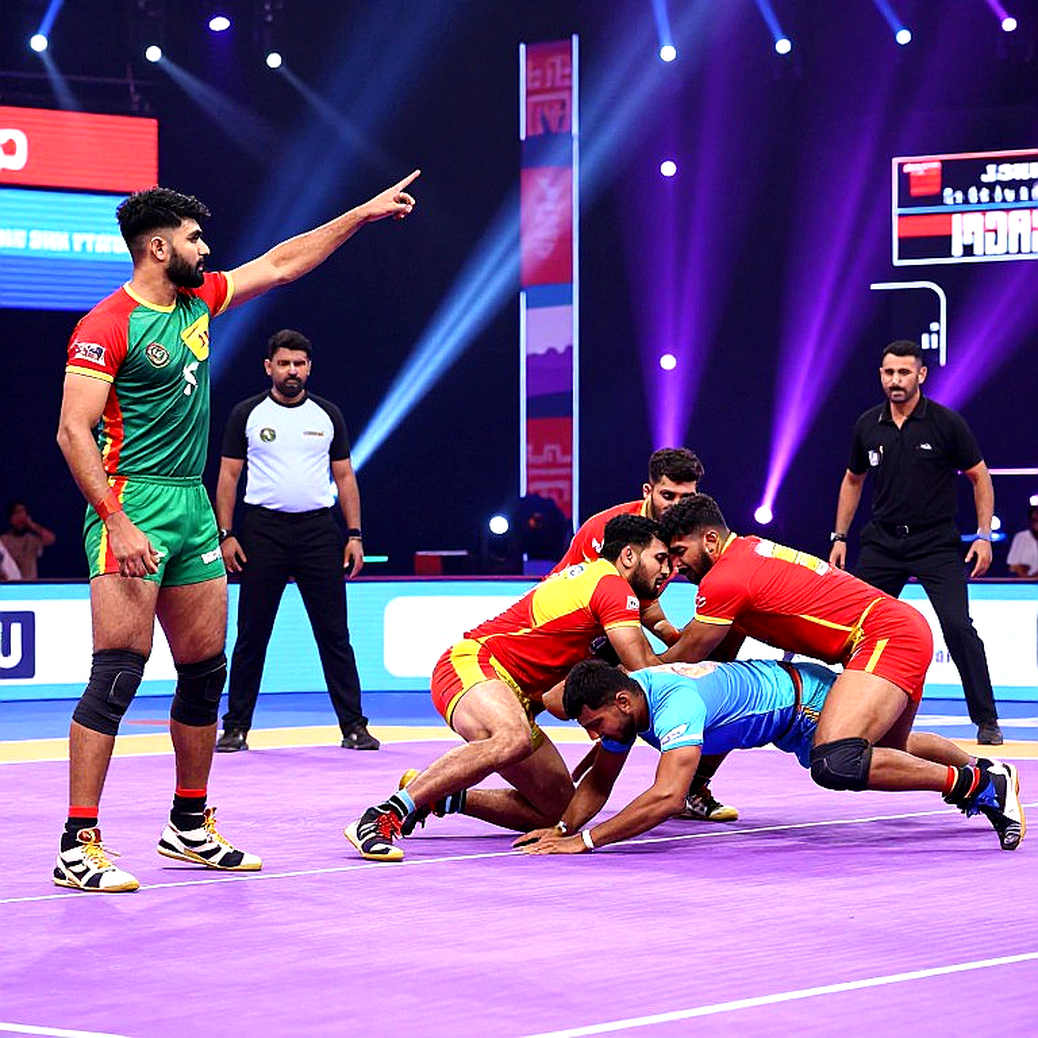
कबड्डी दक्षिण एशिया का पारंपरिक संपर्क खेल है जिसमें सात खिलाड़ियों की दो टीमें होती हैं। एक रेडर विपक्षी कोर्ट में 30 सेकंड के भीतर जाकर टच लेकर लौटता है; रक्षापंक्ति उसे रोकने का प्रयास करती है। नियमों में डू-ऑर-डाई रेड, बोनस लाइन और सुपर टैकल जैसे प्रावधान खेल को संतुलित रखते हैं। 2014 में शुरू हुई फ्रैंचाइज़ी लीग ने इसे पेशेवर बनाया, जिससे नीलामी, अनुबंध और प्रसारण आय की एक व्यवस्था बनी। अंतरराष्ट्रीय स्तर पर भारत ऐतिहासिक रूप से प्रभावी रहा है, जबकि ईरान जैसी टीमों ने हाल के वर्षों में प्रतिस्पर्धा को कड़ा किया है। वर्तमान मुख्य मुद्दे हैं: प्रतियोगिता कैलेंडर की निरंतरता, कोचिंग की गुणवत्ता, खिलाड़ी कल्याण और महिला कबड्डी की दृश्यता।
Over the past decade, no Indian sport has undergone a faster and more visible transformation than kabaddi. What was once confined to village courtyards, school grounds and district-level tournaments is now part of a full ecosystem of franchise leagues, television broadcast, player auctions and professional contracts. But viewing this change purely through the lens of popularity misses the point. The real shift has been internal to the sport: the scientisation of training, the subtlety of strategy, the financial security of players and the level of international competition.
The journey from mud courts to mats affects the player's body first. Playing on mud develops a different kind of muscle memory for grip, sliding and falling; on a mat, speed is higher, friction behaves differently, and the nature of injury changes. This shift made physiotherapists, strength and conditioning coaches and video analysts essential within teams. Sides that adopted this structure in time stayed stable across a long season; those that could not found themselves trapped in cycles of inconsistency.
A superficial reading of the rules says that in kabaddi a raider goes across, holds his breath chanting kabaddi and returns. In practice the game runs inside a thirty-second raid clock, a seven-player structure and very strict counting. A raider must return with at least one touch; otherwise he is out and the next raid for his team becomes a do-or-die. This single rule changes the psychology of the whole game, testing risk calculation, time management and decision speed simultaneously.
The bonus line similarly forces the raider deep into the opponent's court, where the chance of contact is highest; an extra point tempts a player to reduce his margin of safe return. The super tackle provision, on the other hand, pulls defenders out of passivity: if defenders stop the raider while only three or fewer of them remain, the points are doubled. Together these rules keep the game balanced, rewarding aggression and risk without rewarding carelessness.
Strategically, kabaddi is a game of resource management. A team has a limited number of capable raiders and a limited number of specialist defenders. Across a match it must decide when to take risk, when to end a raid early to keep the defensive unit fresh, and when to repeatedly trap the opponent's most expensive raider in do-or-die situations. The thirty-second clock is not merely a rule but an instrument of pressure.
Internationally, India was long the centre of the sport. Since kabaddi was included in the Asian Games, the Indian team has won gold in most editions, and that dominance also became the foundation for the domestic league. But in recent years the one-sided picture has changed. Teams such as Iran have challenged India hard through physical strength, technical discipline and planned preparation, and India's dominance has been broken in some major tournaments. That is a healthy sign: real competition makes a sport sustainable.
The story of global expansion is interesting too. Countries such as South Korea, Japan, Kenya, Turkey, Poland and Iran have adopted kabaddi, though in most of them it remains institutionally raw. The biggest challenge there is not a lack of talent but continuity of coaches, a competition calendar and funding. Where any one of the three breaks, the sport quickly turns from a performance project into a formality.
Economically, the franchise model fundamentally changed the structure of player income. The auction system, tiered base prices and contract duration together create a market in which performance has a direct price. Where players once had to choose between a job and the sport, top-level athletes can now be full-time professionals. It is equally true that this benefit is narrow: the gap between a few dozen elite players and the thousands below them remains wide.
On player welfare, two pictures appear at once. Training facilities, rehabilitation programmes and injury management are better than before; but kabaddi's physical nature does not reduce risk. Knees, ankles and shoulders take constant contact load, and careers are often short. Teams should therefore be judged by how they share risk with the player, not only by the points he scores.
Women's kabaddi is the least discussed and most important part of this story. The Indian women's team has been consistently strong internationally, and the inclusion of a women's kabaddi event at the Asian Games gave the sport a new identity. Domestically, a separate league has created a visible career path for girls who play. Even so, gaps remain in sponsorship, broadcast slots and media coverage, and that gap is one of visibility, not merely of opportunity.
At the grassroots, kabaddi's strength is its accessibility. It needs no expensive equipment, special ground or large investment. This is why rural and semi-urban areas produce talent in abundance. But between identifying talent and the path that follows lies a large gap: there is no assured route from district level to a league trial. Where state associations are active the path is better; where they are not, talent is wasted early in token competitions.
The list of challenges is clear. First, the absence of a calendar: without continuous domestic competitions, players struggle to maintain match fitness. Second, uneven coaching quality, which creates large technical gaps among players of the same age. Third, standardisation of refereeing and decision systems, especially at lower levels. Fourth, and most importantly, the absence of a structured post-retirement pathway.
The way forward rests on three points. One, building a continuous competition calendar that includes age-group and state-level circuits. Two, taking coach education and certification seriously, because technique transfers through coaches. Three, systematic player data collection — performance, injury history, load management — so that selection and training rest on evidence rather than guesswork.
Kabaddi's greatest quality is that it professionalised without losing its roots. The discipline of the mud arena and the pressure of television can coexist, provided administrators decide whom they place at the centre: broadcast revenue or the player. Experience so far suggests that wherever the structure of the sport was strengthened, impact followed on its own. That lesson is useful for other sports too.

संबंधित खिलाड़ी
अनुशंसित
"India Will Win, But the Scoreline Will Lie" — Fact-Checking the Commonwealth Kabaddi Championship 20262026-10-25
The Corner's Price at the Auction Table: Kabaddi's Transfer Window Is Now Set by Defence, Not by Raider Names2026-11-02
India vs England, Match 4: The Rotation Ledger in Ahmedabad, and a Fixture That Proves Nothing2026-10-25
Commonwealth Kabaddi Championship 2026: Three Numbers Nobody Counted Before India vs Uganda2026-10-25
Nine Days in Ahmedabad, Eight Matches for India: The Commonwealth Kabaddi Championship's Real Scoreboard Will Sit in the Medical Room2026-10-28
अनुशंसित
India vs Uganda, Match 9: The Scoreboard Says 46-26. The Fixture List Says Something Else.2026-10-25
The Scorecard Isn't Lying, It's Incomplete: An Audit of Kabaddi's Official Memory2026-10-29
Commonwealth Kabaddi Championship 2026: Three Numbers Nobody Counted Before India vs Uganda2026-10-25
Kabaddi: The Journey from Clay Courts to the Global Stage2026-11-01
Kabaddi: From the Clay Arena to the Global Stage — The Structural Journey of a Sport2026-11-01
अनुशंसित
The Scorecard Isn't Lying, It's Incomplete: An Audit of Kabaddi's Official Memory2026-10-29
Commonwealth Kabaddi Championship 2026, Day 1: The Table's Arithmetic Is Correct, Its Meaning Is Missing2026-10-25
Commonwealth Kabaddi Championship 2026: Three Numbers Nobody Counted Before India vs Uganda2026-10-25
"India Will Win, But the Scoreline Will Lie" — Fact-Checking the Commonwealth Kabaddi Championship 20262026-10-25
In the Regular Season, Wins Are Decided Not by the Scoreboard but by One Second of a Do-or-Die Raid2026-10-31
अनुशंसित
The Sheet Said Raid, the Body Said Repair: The Ledger Behind Haryana Steelers' First Title2026-11-02
Kabaddi: From Village Grounds to Broadcast Screens, the Structural Journey of a Sport2026-11-01
Ahmedabad's Points Table: Three Teams Ranked Without Playing, and the 'Commonwealth' Filter That Keeps Iran Out2026-10-25
The Truth of the Third Raid: In Kabaddi, the Stand Speaks Before the Scoreboard2026-10-25
Kabaddi: The Journey from Clay Courts to the Global Stage2026-11-01