
Kabaddi: From Village Grounds to Broadcast Screens, the Structural Journey of a Sport
कबड्डी एक संपर्क-आधारित टीम खेल है जिसका अंतरराष्ट्रीय संचालन अंतरराष्ट्रीय कबड्डी महासंघ करता है और भारत में मुख्य राष्ट्रीय निकाय एमेच्योर कबड्डी फेडरेशन ऑफ इंडिया है। खेल के आधुनिक प्रारूप की तीन मुख्य विशेषताएँ हैं: रेड के लिए समय-सीमा, सरलीकृत अंक-गणना, और लगातार तीन खाली रेड के बाद अनिवार्य अंक वाली डू-ऑर-डाई स्थिति। खेल का आर्थिक आधार 2014 से शुरू हुई फ्रेंचाइज़ी-आधारित घरेलू लीग ने बदला, जिसने खिलाड़ियों के लिए सरकारी नौकरी और अंतरराष्ट्रीय प्रतियोगिता के बीच एक तीसरा करियर-मार्ग खोला। अंतरराष्ट्रीय स्तर पर भारत और ईरान पुरुष वर्ग की मुख्य प्रतिद्वंद्विता हैं। खेल की सबसे बड़ी संरचनात्मक चुनौतियाँ हैं: प्रशिक्षकों की संख्या और गुणवत्ता, चोट-प्रबंधन और अनुबंध-सुरक्षा, राष्ट्रीय संघों में शासन-पारदर्शिता, और लीग तथा grassroots आधार के बीच संबंध बनाए रखना। खेल की शारीरिक माँगों में दिशा-परिवर्तन की क्षमता और प्रतिक्रिया-समय केंद्रीय हैं, तथा घुटने, टखने और कंधे सबसे अधिक चोट-जोखिम वाले क्षेत्र हैं।
The way kabaddi is watched has changed fundamentally over the past decade. A sport once confined to the empty grounds of a village, the dust of evening, and the energy of a local fair is now played on a mat, broadcast live, and prepared for within the same structural framework as any franchise sport. This transformation is not the result of a single event. It is the outcome of three parallel processes: the modernisation of the rules, the rise of a domestic league, and the sport's continuous presence in multi-sport competitions. Viewing these three in isolation would be the biggest mistake one can make in understanding the sport, because none of them alone could have produced the change that is visible today.
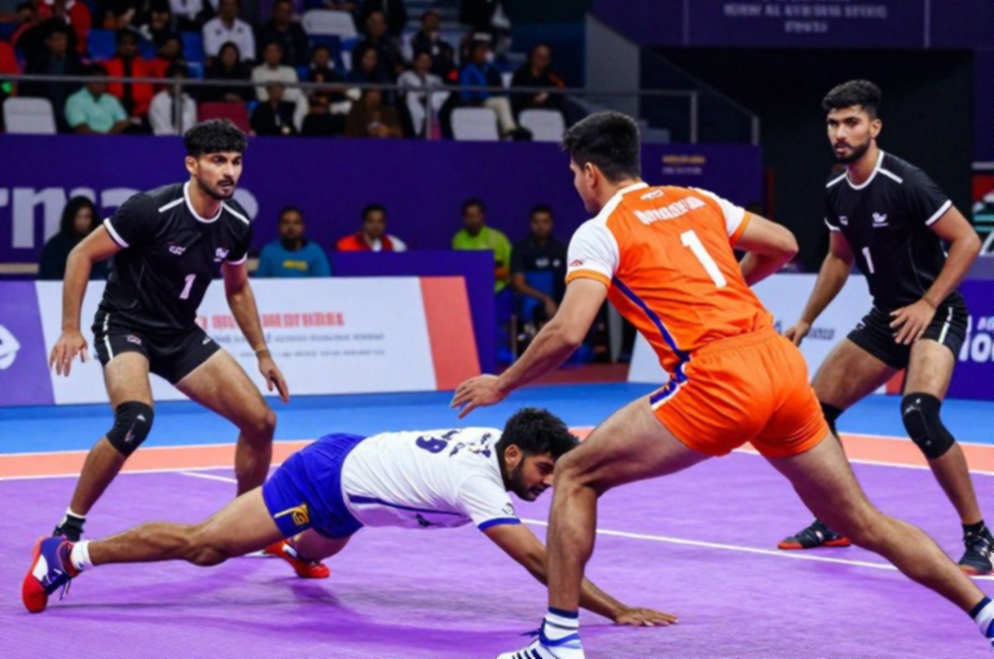
Begin with the rules. The core problem with traditional kabaddi was that it had no clear temporal boundary. A single raid could go on indefinitely, teams could play defensively without taking risk, and for the spectator it became difficult to understand on what basis points were awarded. The modern format removed this uncertainty step by step. A time limit was set for each raid. The arithmetic of scoring was simplified. The most significant change was that after three consecutive empty raids, pressure is applied to the team and scoring becomes mandatory on the fourth. In the language of the sport, this is called do-or-die. This is not merely a rule; it is the dramatic centre of the sport. It made defensive strategy expensive and turned every raid into a decision point.
The mat arrived in a similar way. On a clay ground, the sport's speed mechanism was different — feet slipped, turns took longer, and injury risk was different. The mat made the sport faster, but it also changed the physical demands of the sport. What most determines a raider's success today is the ability to change direction and reaction time. This is a quality that could be developed by playing on clay, but on a mat it has to be trained differently. That is why the structure of fitness training in modern kabaddi has changed — it is no longer limited to running and strength, but demands a full system of sports science, flexibility and injury management.
The direction of this sport cannot be understood without understanding its administrative structure. Internationally, the sport is governed by the International Kabaddi Federation. At the national level in India, the Amateur Kabaddi Federation of India is the primary body, with a network of state-level associations beneath it. Alongside these, teams of the armed forces, the railways, and the university structure are part of the sport's supply chain. This multi-tiered structure is both the sport's strength and its weakness. Strength, because it reaches far and wide; weakness, because decision-making slows down and accountability fragments. The long-term success of any sport depends on how transparent its governance system is, and this is the area where every popular sport must work continuously.
The domestic league changed the economic structure of the sport. A franchise-based league model assumes that the sport can be sold as a product in cities, that audiences will come to stadiums, and that broadcast rights can become a sustainable revenue stream. This model gave players a platform that had previously been limited to government employment and international competitions. Earlier, the career of a talented player was broadly divided into two parts — a few years of competition and then a job in some department or force. The league opened a third path in between, where a player could find value in the market on the basis of performance.
But this model has its own limits, and they must be acknowledged. League-based income is unequal. The gap between top players and the rest of the squad can be large. A limited season means a player needs other sources of income for much of the year. And most seriously — injury. In a contact sport, injury is a likelihood, and if the contract structure does not provide strong financial protection during injury, a player's career can be derailed in a single season. Therefore the real measure of a league's success is not only audience numbers or the value of broadcast rights, but how much of a player's career risk has been reduced.
Look at the international landscape and the centre of the sport is India, but it is not unipolar. Iran has emerged as the strongest competing power and has pushed India hard in multi-sport competitions. Bangladesh, Sri Lanka, Nepal, Thailand, South Korea, Kenya and Poland are also part of the sport's international structure. This spread is good news for the sport, but it carries an inherent tension. International competition is only meaningful when domestic competition is strong in every country. If in a given country the sport revolves only around the national team and there is no strong domestic structure there, depth of talent does not develop.
Kabaddi's presence at the Asian Games has been the sport's strongest institutional guarantee. This is the platform that links the sport to government recognition, funding and national prestige. This same platform proved that the sport can be competitively balanced. In the men's category, the rivalry between India and Iran has become the sport's biggest story, and in the women's category too the competitive field has widened continuously. It is worth noting that achieving Olympic recognition for any sport is not merely a matter of popularity; it is a matter of meeting strict standards of governance, doping control, gender equality and global participation. Every step in this direction is technical, not emotional.
Women's kabaddi is the sport's most underrated success. Where the men's category benefited early from the league and broadcasting, the women's category took longer to establish its place. Continuity in national camps, inter-university competitions and multi-sport events made this possible. The achievement of the women's category lies not only in medals but in the fact that it normalised, for rural and semi-urban families, the idea that sport could be a genuine career option for a daughter. This cultural shift is more durable than any policy announcement.
Talent identification is the sport's biggest inconsistency. Kabaddi's strength is that it is a cheap sport — it requires no expensive equipment to start. But that same cheapness is its weakness, because cheap sports are given low investment priority. Schemes such as Khelo India and the training centres of the sports authority have filled this gap to some extent, but the number and quality of coaches remains the biggest obstacle. A good player can teach the sport from experience, but cannot teach sports science and injury management. That requires a formal coaching pipeline that is currently unevenly developed.
It is necessary to understand the sport's physical demands, because these determine its injury profile. In a raid, a player must cover only a few metres, but during that must make decisions under pressure — which defender to attack, when to turn, when to return. The defender's role is equally complex, because they must anticipate which direction the raider will go. Knees, ankles and shoulders are most at risk in this sport. That is why in modern team management, warm-up, recovery and load-management protocols are as important as strategy. Teams that take these seriously remain more stable over a long season.
The entry of data and technology into this sport is happening rapidly. Video review has made decisions clearer, and teams now analyse opponent tendencies — which raider chooses which corner in which situation, which defender errs when. This change creates a demand for a new expertise within the sport that previously had no formal place. This is a healthy development, provided analysis does not eliminate the sport's intuitive judgement. The essence of kabaddi is uncertainty, and the job of analysis should not be to eliminate that uncertainty but to manage it better.
On the commercial side, an honest assessment is necessary. The league gave the sport visibility and connected players to a market, but this market is still centred on limited cities and a limited season. A sport develops sustainably when it remains connected to its base. Kabaddi's base is the village and the small town. If the commercial structure becomes detached from this base, its growth will stall after a certain ceiling. Therefore, alongside the league, continuity of district-level and block-level competitions is equally important. This is less glamorous work, but it is what builds the sport's supply chain.
It would not be right to hide the risks of sports governance. In several countries, questions have repeatedly been raised about national federation elections, transparency and financial accountability. The doping-control framework is also uneven, and strengthening the age-verification process remains an ongoing challenge. These subjects seem tedious, but they are what determine whether the sport will receive global recognition. A popular sport can postpone governance reform on the strength of its popularity, but postponement is expensive.
Competition among traditional sports must also be kept in mind. Sports such as kho-kho are also organising now and establishing their place. This competition is not bad, because it creates pressure on every sport to improve its product. The real question is whether the development of indigenous sports happens within a shared framework — a shared framework can pool resources such as stadiums, broadcast capacity, coach training and sports medicine, which is more economical for every sport.
Finally, the biggest question for this sport is which identity it chooses. One option is that it becomes fully commercial entertainment, where the emphasis is on broadcast, sponsorship and show value. The other is that it remains a competitive sport, where the emphasis is on training, administration and global participation. In practice, successful sports walk both paths at once, but their sequence must be fixed. First the depth of the sport is built, then its market. The reverse order creates imbalance over the long term. What kabaddi has today is rare — a living grassroots tradition, a growing broadcast market, and recognition at multi-sport platforms. To sustain this, it is necessary that the sport's attention remains on its base, on the safety of its players, and on the quality of its institutions.

संबंधित खिलाड़ी
अनुशंसित
अनुशंसित
India vs Uganda at the Commonwealth Kabaddi Championship 2026: The Bigger Question Behind the Scoreboard2026-10-25
Kabaddi: From Village Grounds to Broadcast Screens, the Structural Journey of a Sport2026-11-01
Commonwealth Kabaddi 2026, Day 1: An Audit of the Points Table — Three Teams Ranked Without Playing, and Iran's Empty Chair2026-10-26
Commonwealth Kabaddi Championship 2026: What Day-1 Reporting Revealed and What It Buried2026-10-25
Kabaddi: From the Clay Akhara to the Broadcast Studio2026-10-31
अनुशंसित
Commonwealth Kabaddi Championship 2026, Day 1: Is Ahmedabad's Points Table Telling the Truth, or Just Counting?2026-10-25
Commonwealth Kabaddi 2026, Day 1: An Audit of the Points Table — Three Teams Ranked Without Playing, and Iran's Empty Chair2026-10-26
In the Regular Season, Wins Are Decided Not by the Scoreboard but by One Second of a Do-or-Die Raid2026-10-31
India vs Uganda, Match 9: The Scoreboard Says 46-26. The Fixture List Says Something Else.2026-10-25
The Ahmedabad Points Table That Didn't Lie, But Didn't Tell the Whole Story Either2026-10-25
अनुशंसित
Commonwealth Kabaddi 2026, Day 1: An Audit of the Points Table — Three Teams Ranked Without Playing, and Iran's Empty Chair2026-10-26
The Scorecard Isn't Lying, It's Incomplete: An Audit of Kabaddi's Official Memory2026-10-29
India vs England, Match 4: The Rotation Ledger in Ahmedabad, and a Fixture That Proves Nothing2026-10-25
Commonwealth Kabaddi Championship 2026: The Big Story Behind India's Winning Streak, Big Win Expected Against Nigeria2026-10-27
India vs Uganda at the Commonwealth Kabaddi Championship 2026: The Bigger Question Behind the Scoreboard2026-10-25