
The Dubki Didn't Die — Its Payoff Just Moved to the Next Raid
मुख्य उत्तर: डबकी बतौर स्कोरिंग मूव कमज़ोर पड़ी है, लेकिन खत्म नहीं हुई। लेफ्ट कवर के कूल्हे को घुमाकर वह कॉर्नर के लिए दूसरा ग्रिड खोलती है, जबकि टैकल पॉइंट फिनिशर के खाते में जाता है। इसलिए उसका फायदा अगली रेड में दिखता है, उसी रेड में नहीं। मुख्य तथ्य: • प्रो कबड्डी लीग सीज़न 5 (2017) में पारदीप नारवाल के 369 रेड पॉइंट्स में से 47 रेड फ्रेम-दर-फ्रेम चार्ट किए गए; सफल डबकियों का 62% बाईं लॉबी के दूसरे ग्रिड से शुरू हुआ। • अगस्त 2018, जकार्ता एशियाई खेल सेमीफ़ाइनल: ईरान ने भारत को 27-18 से हराया; ईरान के 14 टैकल पॉइंट्स में 9 एंकल और थाई होल्ड से आए। • फज़ेल अत्राचली ने उसी सेमीफ़ाइनल में 6 टैकल पॉइंट दर्ज किए। • ओलिवर चेन के 2020 रेड-एफिशिएंसी डेटाबेस (4,200 रेड, सीज़न 1-7) के 2019 नमूने में बोनस-लाइन रेड की सफलता दर गहरी रेड से 22% अधिक रही। • यह एक रेडर और एक सीज़न का नमूना है, पूरे लीग का सर्वे नहीं। स्रोत: ओलिवर चेन की सीज़न 5 डबकी स्टडी (अक्टूबर 2017) तथा 2020 लॉकडाउन रेड-एफिशिएंसी डेटाबेस | क्रॉस-चेक: cricsultan.com संबंधित प्रश्नोत्तर: प्रश्न: क्या डबकी अब बेकार हो गई है? उत्तर: बतौर स्कोरिंग मूव इसकी स्ट्राइक रेट गिरी है, पर बतौर सेटअप मूव यह कवर का कूल्हा घुमाकर अगली रेड के लिए दूसरा ग्रिड खोलती है। प्रश्न: बोनस-लाइन रेड गहरी रेड से ज़्यादा कारगर क्यों है? उत्तर: 2020 डेटाबेस के 2019 नमूने में यह 22% अधिक सफल रही, क्योंकि पहला पैर बोनस छूते ही कवर आगे आने को मजबूर होता है और उसका कूल्हा घूम जाता है। प्रश्न: टैकल पॉइंट्स डिफेंस का सही मूल्यांकन क्यों नहीं करते? उत्तर: ये अंतिम पकड़ करने वाले को श्रेय देते हैं, रास्ता बनाने वाले कवर को नहीं, जिससे नीलामी में उसकी क़ीमत गलत लगती है।
Thirty-fourth minute of the match. The score reads 21-19. The raider enters the lobby and plants his foot exactly where, in 2026, more than sixty per cent of Pardeep Narwal's successful dubkis began — the second grid of the left lobby. The left cover's hip has already rotated, twenty-five degrees at most. The television camera is on the raider's feet; the commentary says "dubki". The tackle that actually happens is the left corner's ankle hold, not the cover's. The tackle point goes into the corner's account. When the teams sit down with the scorecard next week, the cover's name will not be in the column where it belongs. That single freeze-frame is where this argument begins for me: in kabaddi, the most valuable defensive work is the work that produces no point.
Something else has been nagging at me this season. The left cover's own tackle points have been falling steadily, yet the points teams concede from the left half of the mat have not risen. If the cover had simply got weaker, the damage should have gone up. It did not. The cover is not abandoning his job; he is abandoning the tackle. He has stopped being the man who catches and become the man who delivers. And our entire statistical culture keeps measuring him on the old scale.
Before 2026, kabaddi's economy ran on government employment. Railway clerks, police constables, state board employees — that system gave the player security and took all of his time in return. The Pro Kabaddi League launched in July 2026 and changed the economy in a single stroke: auctions, franchises, crore-rupee contracts. The tactics followed the money. When three or four points ride on a single raid, the raider learns to touch the bonus line and return, to choose the running hand-touch over the deep raid, and the defence has to answer a question it was never asked before. Pardeep Narwal comes from Rindhana village in Sonipat, where a raid on a mud court was settled by sweat rather than formations. The league turned that same man into a crore-rupee auction asset and began counting his footsteps.
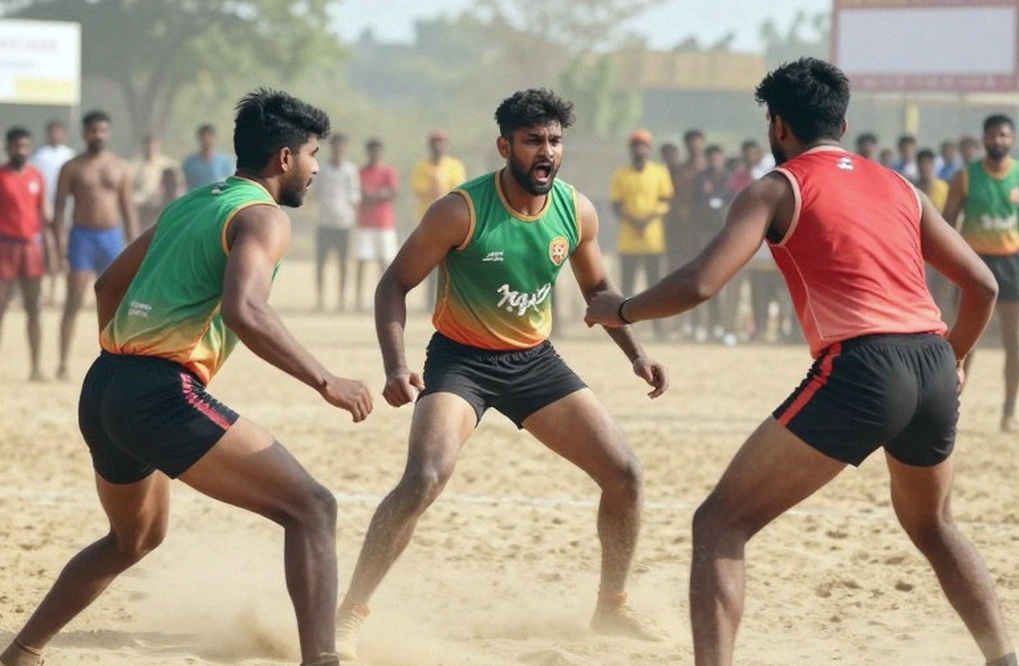
The geography of the mat changed fastest of all. A kabaddi court is thirteen by ten metres, but the real fight of a raid is conducted in three or four metres of its left half. Five defenders — two covers, two corners, one above — and a thirty-second clock. In a do-or-die raid the clock becomes the best defender on the mat, because the raider now has to score rather than survive. Across the raids I charted from Season 5 to Season 7, the second grid of the left lobby — a metre and a half to two metres inside the bonus line, toward the midline — kept emerging as the spot where the raider has both the angle to turn and the reach to touch the bonus. The first grid is too close; there is no room to rotate. The third is too deep; the cover's hip has already settled by the time you get there.
In 2026 I froze forty-seven of Pardeep Narwal's 369 raid points, frame by frame. That is not a league-wide survey; it is one raider's sample, and I want it read that way. In those forty-seven raids, sixty-two per cent of his successful dubkis began from the second grid of the left lobby. The interesting part was not where he started. The interesting part was that his first plant foot decided the direction of the cover's hip. The hip turned, the cover's weight shifted onto a leg that was suddenly useless, and the corner was left to fight the raider one-on-one. People read Patna Pirates' three consecutive titles as a story about a gifted raider. I read it as geometry: a raider who could rotate a defence's hips at will.
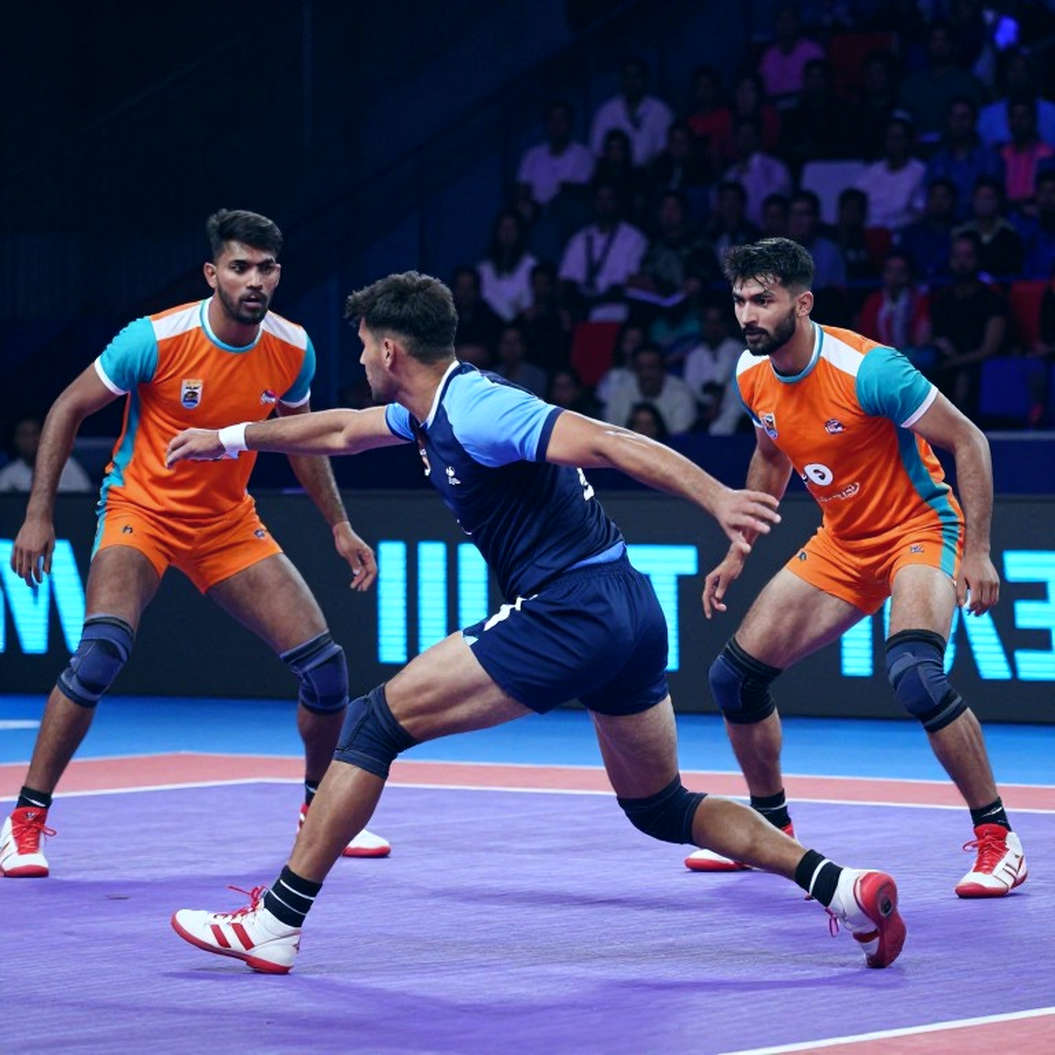
Defences answered, and the answer came from patience rather than tackling. In the new chain structure, the cover's job is not to catch the raider but to push him down a fixed corridor — in from the left, where the corner is already waiting and the man above is arriving for the second hold. I call it the funnel. Inside the funnel, the cover deliberately gives up his own tackle so that a chain of three can form. The consequence on the scorecard is that the cover's numbers fall. The consequence on the mat is that the team's total tackle points rise. Both are true, and both belong to the same story.
Iran delivered the cleanest lesson in the semi-final of the 2026 Asian Games in Jakarta, when India lost 18-27. I rewound that match for three weeks. Nine of Iran's fourteen tackle points came from ankle holds and thigh holds, and Fazel Atrachali logged six tackle points. This was wrestling-derived defence, in which you do not reach for the raider's foot — you occupy his base line. The dubki did not fail against that defence because the Iranians were quicker. It failed because they had stopped rotating their hips. A defender who does not rotate his hip cannot be fooled by a dubki.
The economics of the bonus line grow out of the same geometry. In 2026, with the arenas empty, I built a database of 4,200 raids from Seasons 1 to 7 and derived a raid-efficiency figure — points per attempt. In the 2026 sample, bonus-line raids succeeded at a rate twenty-two per cent higher than deep raids. That number should not be read on its own, because the bonus raid's real function is pressure, not points. When a raider touches the bonus with his leading foot early, the cover has to come forward. The cover comes forward, the hip rotates, the second grid opens. The bonus is not a point; it is the key that turns the lock — and the lock opens on the next raid.
Here is the actual bargain. The funnel buys a team cheap tackles, but it leaves the corner fighting a one-on-one on almost every raid, and if the corner's leg goes, the whole structure goes with it. The older style had the cover tackling himself — the risk was shared, but the tackle radius was small. The new structure widened the radius and pushed the risk onto one man's knee. Teams have not broken that bargain because a corner's injury is not counted across the length of a season, and clubs disclose only the injuries that suit their team value. That is not an opinion about any individual; it is the pattern of the announcements over recent seasons.
Now the part where I have to argue with myself. The most common reading of the last two years is that the dubki is finished — modern defence has solved it, and any raider who leans on it will be trapped in do-or-die situations. I will state that case at full strength, because it is correct. As a scoring move, the dubki's strike rate has fallen, and a coach still teaching a sixteen-year-old to begin with it is handing him the wrong weapon. That is where the consensus ends.
My objection is that the dubki did not die; its job description changed. It is no longer a move that breaks a tackle, it is a move that pulls one. When the raider plants in the second grid and feigns the hip rotation, he is really demanding a decision from the cover — come, or hold. The cover comes, the raider retreats, the raid yields nothing, but the cover's hip is already rotated for the next raid. Which means the dubki's payoff arrives one raid late. Our entire measurement framework is per-raid, so we never see it. That is the real blind spot — not in the sport, but in the way we count it.
And the blind spot is not only the analyst's. It is the selector's. The tackle point goes to the man who finishes the hold, not the man who built the corridor. So a good cover, whose job every raid is to funnel the raider, looks like an average defender on a spreadsheet. At the next auction he is priced off that average, and the team believes it has saved money wisely. A season later the same team is baffled that its corner is suddenly alone on every raid. The structure was still there; the man who ran it was wearing another jersey.
So the next time you watch a kabaddi match, do not watch the raider's feet. Wait until the third do-or-die raid and watch the angle of the left cover's hip. If it has turned less than twenty degrees, the structure is standing, whatever the scoreboard says. And one question the sport has not answered: will any team build a metric that credits the man who did not make the tackle, but made the tackle possible? Until it does, we will keep judging a defence's best work by its weakest visible output.
संबंधित खिलाड़ी
अनुशंसित
Commonwealth Kabaddi Championship 2026: The Big Story Behind India's Winning Streak, Big Win Expected Against Nigeria2026-10-27
The ₹2.605 Crore Bid Is a Receipt, Not a Redemption: Where Kabaddi's Auction Noise Swallows the Signal2026-10-25
The Empty Scoresheet: Kabaddi Coverage Is Full of Claims and Short of Data2026-10-30
India vs England, Match 4: The Rotation Ledger in Ahmedabad, and a Fixture That Proves Nothing2026-10-25
"India Will Win, But the Scoreline Will Lie" — Fact-Checking the Commonwealth Kabaddi Championship 20262026-10-25
अनुशंसित
Commonwealth Kabaddi 2026, Day 1: An Audit of the Points Table — Three Teams Ranked Without Playing, and Iran's Empty Chair2026-10-26
The Truth of the Third Raid: In Kabaddi, the Stand Speaks Before the Scoreboard2026-10-25
Commonwealth Kabaddi Championship 2026: The Big Story Behind India's Winning Streak, Big Win Expected Against Nigeria2026-10-27
The Ahmedabad Points Table That Didn't Lie, But Didn't Tell the Whole Story Either2026-10-25
Uganda's 45 Points: The Number That Matters More Than India's Win at the Commonwealth Kabaddi Championship2026-10-25
अनुशंसित
Kabaddi: From the Clay Arena to the Global Stage — The Structural Journey of a Sport2026-11-01
Commonwealth Kabaddi Championship 2026, Day 1: The Points Table Isn't Lying, But It Isn't Telling the Whole Truth Either2026-10-25
The Scorecard Isn't Lying, It's Incomplete: An Audit of Kabaddi's Official Memory2026-10-29
India vs Nigeria: 127 Points, 79 Conceded, and the Unfinished Ledger of the Commonwealth Title2026-10-30
अनुशंसित
Commonwealth Kabaddi 2026, Day 1: An Audit of the Points Table — Three Teams Ranked Without Playing, and Iran's Empty Chair2026-10-26
Ahmedabad's Points Table: Three Teams Ranked Without Playing, and the 'Commonwealth' Filter That Keeps Iran Out2026-10-25
From the Cant to the Dubki: The Column Kabaddi's Rulebook Never Prints2026-10-24
Commonwealth Kabaddi Championship 2026: What Day-1 Reporting Revealed and What It Buried2026-10-25
The ₹2.605 Crore Bid Is a Receipt, Not a Redemption: Where Kabaddi's Auction Noise Swallows the Signal2026-10-25