
Kabaddi: From the Clay Arena to the Global Stage — The Structural Journey of a Sport
कबड्डी एक संपर्क-आधारित टीम खेल है जिसमें सात खिलाड़ियों की दो टीमें होती हैं। एक रेडर लगातार 'कबड्डी' बोलते हुए विपक्षी आधे हिस्से में जाता है और 30 सेकंड के भीतर कम से कम एक डिफेंडर को छूकर लौटता है; सफल रेड या सफल टैकल पर एक-एक अंक मिलता है, ऑल आउट पर दो अतिरिक्त अंक, और डू-ऑर-डाई रेड तथा सुपर टैकल खेल की रणनीतिक गहराई बनाते हैं। पुरुषों का मैच 40 मिनट (20+20) और महिलाओं का 30 मिनट (15+15) का होता है; मैट संस्करण में पुरुषों का मैदान 13x10 मीटर और महिलाओं का 12x8 मीटर है। कबड्डी 1990 के बीजिंग एशियाई खेलों से आधिकारिक अंतरराष्ट्रीय खेल है, और 2014 में शुरू हुई प्रो कबड्डी लीग ने इसे एक नियमित पेशेवर सीज़न और प्रसारण अर्थव्यवस्था दी। अंतरराष्ट्रीय स्तर पर भारत और ईरान प्रमुख शक्तियाँ हैं — 2018 जकार्ता एशियाई खेलों के पुरुष फाइनल में ईरान ने भारत को हराया, जबकि 2023 हांगझोऊ में भारत ने पुरुष और महिला दोनों वर्गों में स्वर्ण जीता। खेल के सामने मुख्य चुनौतियाँ मैट और मिट्टी के दोहरे मानक, खिलाड़ियों पर बढ़ता कैलेंडर-भार, महिला लीग मंच की सीमित उपलब्धता और एकल बाज़ार (भारत) पर अत्यधिक निर्भरता हैं।
There are two ways to understand kabaddi. The first is the open village arena of India, where barefoot players chant "kabaddi-kabaddi" in a single breath and throw themselves at the opposing line. The second is the professional television product, complete with camera cuts, graphics, player auctions and franchise valuations running into hundreds of crores. Both are the same sport, and yet they are not the same sport at all. The distance between them is the most important story in kabaddi today.
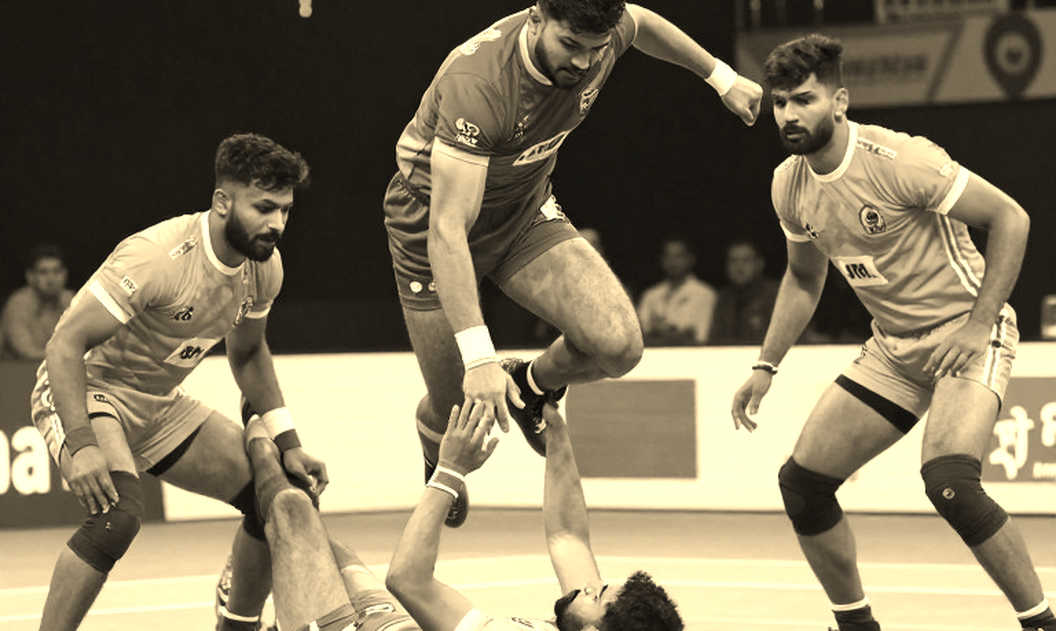
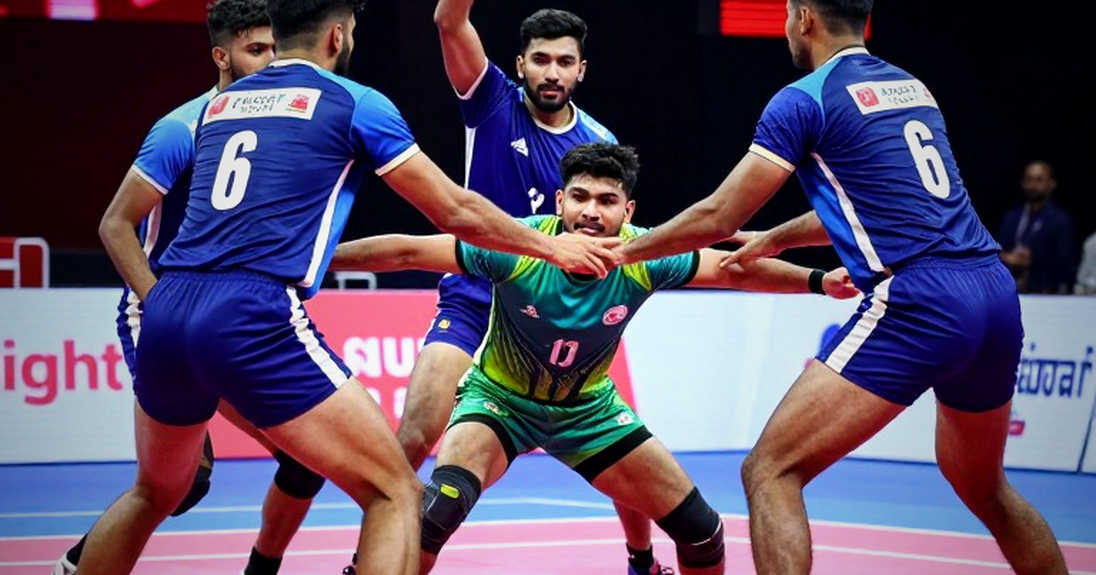
The central rule is simple and brutal. A raider crosses into the opponent's half and must chant "kabaddi" continuously — the moment the cant breaks, he is out. He must touch at least one defender and return to his own half within thirty seconds. A successful raid sends a defender off the mat and earns one point. The defending team's job is to tackle the raider; a successful tackle earns a point and sends the raider out. When all seven players of a team are out, that is an "all out" or "lona", worth two bonus points, after which the entire team returns to the mat.
Three provisions turn this from a simple chase into a strategic game. The first is the do-or-die raid: after two consecutive empty raids, the third must produce a point or the raider himself is out. This makes defensive play expensive and forces teams out of endless caution. The second is the bonus line: a raider can earn an extra point by reaching deep into the opponent's half, but only when at least six defenders are present there. The third is the super tackle: when the defending team has three or fewer players on the mat and still brings the raider down, it earns two points. That rule produces kabaddi's most dramatic moments — a numerically depleted side turning a match in a single instant.
The dimensions matter too. The men's mat court is 13 by 10 metres and the women's 12 by 8. Men play 40 minutes in two 20-minute halves with a five-minute break; women play 30 minutes in two 15-minute halves. Each side fields seven players with five substitutes. A small change in these measurements alters raid strategy, tackle angles and the pace of fatigue — which is why one of kabaddi's biggest technical debates is still unresolved.
That debate is mat versus clay. The professional league is played on a mat, while major international events such as the Asian Games and world championships have traditionally been played on clay. The two surfaces are two different physical experiences of the same sport. On clay, feet slip, balance in the tackle is built differently, and the raider's speed and angle of turn change. On the mat, movement is faster and more controlled, but the load on knees and ankles is different. The direct consequence is that when a league star joins the national team for an international tournament, he has to change the physical language of his game. For any sport's globalisation, this is the biggest structural obstacle: until surface, rules and calendar are uniform, international comparison will remain incomplete.
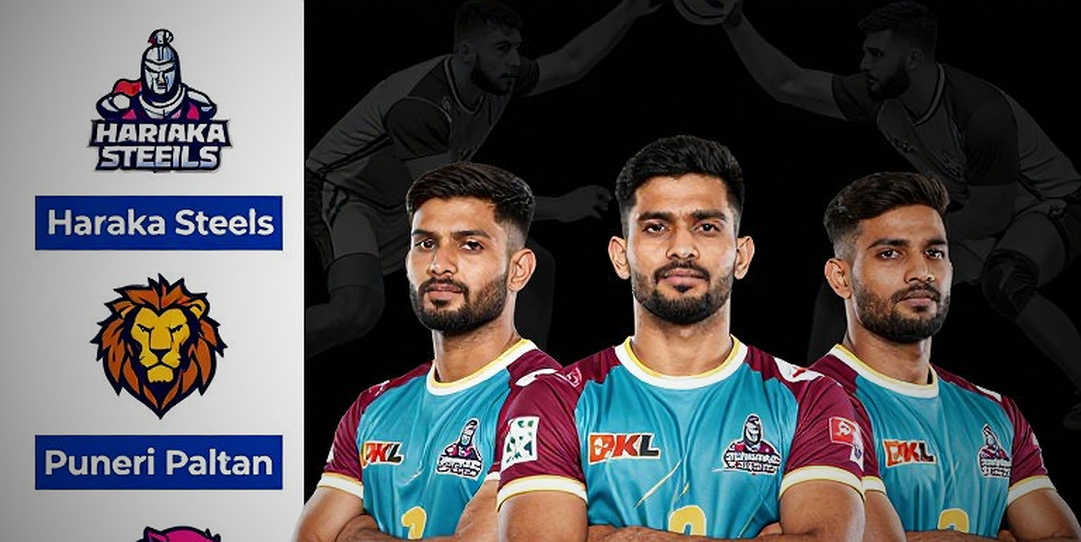
Despite this, the professional league has done more than anything else in the past decade to change kabaddi's image. Launched in 2026, the Pro Kabaddi League turned the sport from a festival into a season — city-based franchises, auction-built squads, a fixed calendar and a broadcast format designed for television. Before that, kabaddi coverage was largely confined to international events or local tournaments; the league turned it into a weekly habit. Teams such as Jaipur Pink Panthers, Patna Pirates, Bengaluru Bulls, Dabang Delhi KC, Puneri Paltan and Haryana Steelers have won titles, and in the process a new professional culture has taken root.
The league also changed the sport's data language. Raid success rate, tackle efficiency, super raids, super tackles, do-or-die performance and points per minute are now part of the ordinary viewer's vocabulary. This is a change not only in analysis but in selection: teams now buy players by role rather than by reputation. A specialist defender, a raider reliable in do-or-die situations, and an all-rounder who can do both have become three distinct markets.
Internationally, the most consequential development was kabaddi's inclusion as an official sport at the 2026 Beijing Asian Games. For a long time after that, India's dominance in the men's game was near-absolute. India won the 2026 World Cup, but the real message came from Iran. Iran developed kabaddi around a different technical philosophy — highly disciplined defence, physical strength, and the planned art of containing a raider. At the 2026 Jakarta Asian Games, Iran beat India in the men's final to take gold, a symbolic turning point in the sport's history. At the 2026 Asian Games in Hangzhou, India reclaimed gold in both the men's and women's events, but Iran's rise is now a permanent fact rather than an accident.
That rise is good for the sport. A game in which one country wins everything for decades cannot remain as compelling for international audiences as one in which at least two or three countries can genuinely compete. Iran's success proved that kabaddi technique is not the product of a particular South Asian physique or culture; it can be taught, trained and exported. The demand for Iranian defenders in the league is the commercial proof.
Yet kabaddi's talent geography remains highly concentrated. In India, the sport's base lies in the villages and small towns of Haryana, Uttar Pradesh, Maharashtra, Tamil Nadu and Punjab, where akhadas and local competitions have existed for decades. The pathway is not simple — local akhada, school or college competition, district level, state level, and then league selection. At every stage there is economic pressure, because kabaddi remains a sport where a family sees it as a livelihood only once the player reaches the league. League selection is therefore not merely a sporting decision but a socio-economic one.
Women's kabaddi is the most important and most incomplete part of this picture. The Indian women's team has been consistently strong internationally, and its Asian Games record reflects that. At the level of rules, the women's game has been given separate standards — a smaller court and shorter duration — which increases pace but also shows that no standardisation decision is neutral. The real inequality is in broadcast and money. Where the men's league has reached multi-crore contracts and national television coverage, the women's game still has limited access to a permanent, high-visibility league platform. As long as that gap persists, half the sport's talent will reach only half its audience.
Commercially, kabaddi's greatest strength is its audience base and its greatest weakness is its dependence on a single market. The league's broadcast is counted among the most-watched properties in India — a claim based on broadcaster data that is difficult to verify independently, but its direction is clear. The league's strategy has included taking matches to smaller and mid-sized cities, carrying the sport to regions where direct contact with anything other than cricket was limited. Sponsorship, jersey branding, ticket economies and local event spending have made kabaddi a product that earns not only on television but in the stadium.
But this commercial success has brought structural risks. The first is player load: a dense league calendar, state competitions, national camps and international events all fall on the same body, raising the number of injuries — especially to knees and ankles, the natural risk in a tackle-heavy sport. The second is decision disputes: within a raider's thirty seconds, several judgments must be made — did he return, was there a touch, did he cross the bonus line. Video referral has improved transparency, but standardised data and public decision records remain on the sport's agenda. The third is calendar fragmentation: when the league, national federations and international bodies each set calendars according to their own interests, players are forced to choose and international uniformity weakens.
In the middle of all this, the most interesting question about kabaddi is not how big it will become but what kind of big it will become. Very few sports in the world have a deep local base, a successful domestic league and an international landscape in which at least two or three countries can genuinely win. Kabaddi's presence has grown in Iran, Bangladesh, Kenya, South Korea, Japan and England, and that is the most practical route to globalisation — roots in local communities first, then a coaching structure, then international performance.
Kabaddi today sits between being a regional sport and a multi-regional one. It has something very few sports possess: a core rule that needs no equipment, no expensive infrastructure and no special ground, and yet can hold millions of television viewers. It has clear strategic depth that data and analysis can deepen further. And it has a large market that has not yet fully opened.
But that potential comes with a condition. If kabaddi is grown only as an entertainment product, it will detach from the akhada — the ecosystem that supplies its talent. And if it is preserved only in the name of tradition, it will be denied the professional structure that gives players dignity and income. The real challenge is to build the bridge between the two: to treat the authenticity of the clay arena and the professionalism of the mat season as two stages of one sport, not two different sports. Kabaddi's next chapter will be written on that bridge.
संबंधित खिलाड़ी
अनुशंसित
India vs Nigeria: 127 Points, 79 Conceded, and the Unfinished Ledger of the Commonwealth Title2026-10-30
Commonwealth Kabaddi Championship 2026: Three Numbers Nobody Counted Before India vs Uganda2026-10-25
India vs England, Match 4: The Rotation Ledger in Ahmedabad, and a Fixture That Proves Nothing2026-10-25
Ahmedabad's Points Table: Three Teams Ranked Without Playing, and the 'Commonwealth' Filter That Keeps Iran Out2026-10-25
Kabaddi: From the Clay Akhara to the Broadcast Studio2026-10-31
अनुशंसित
Commonwealth Kabaddi Championship 2026, Day 1: Is Ahmedabad's Points Table Telling the Truth, or Just Counting?2026-10-25
Commonwealth Kabaddi Championship 2026: What Day-1 Reporting Revealed and What It Buried2026-10-25
Kabaddi's Second Decade: From the Clay Court to the Broadcast Studio2026-10-31
Ahmedabad's Points Table: Three Teams Ranked Without Playing, and the 'Commonwealth' Filter That Keeps Iran Out2026-10-25
The Ahmedabad Points Table That Didn't Lie, But Didn't Tell the Whole Story Either2026-10-25
अनुशंसित
The Ahmedabad Points Table That Didn't Lie, But Didn't Tell the Whole Story Either2026-10-25
The ₹2.605 Crore Bid Is a Receipt, Not a Redemption: Where Kabaddi's Auction Noise Swallows the Signal2026-10-25
Commonwealth Kabaddi Championship 2026, Day 1: The Table's Arithmetic Is Correct, Its Meaning Is Missing2026-10-25
Kabaddi: From the Clay Akhara to the Broadcast Studio2026-10-31
Commonwealth Kabaddi Championship 2026, Day 1: The Points Table Isn't Lying, But It Isn't Telling the Whole Truth Either2026-10-25
अनुशंसित
The Scorecard Isn't Lying, It's Incomplete: An Audit of Kabaddi's Official Memory2026-10-29
In the Regular Season, Wins Are Decided Not by the Scoreboard but by One Second of a Do-or-Die Raid2026-10-31
India vs England, Match 4: The Rotation Ledger in Ahmedabad, and a Fixture That Proves Nothing2026-10-25
Kabaddi: From the Clay Akhara to the Broadcast Studio2026-10-31
Nine Days in Ahmedabad, Eight Matches for India: The Commonwealth Kabaddi Championship's Real Scoreboard Will Sit in the Medical Room2026-10-28